No Products in the Cart


Last Updated: September 22, 2026
The right pickleball grip size for small hands prevents hand fatigue, loss of control, and wrist or elbow pain. A grip that's too large forces your hand to stretch awkwardly; too small creates instability and compensating movements that wear out your joints.
Many casual players dismiss grip size as minor, but after a few weeks of play they notice forearm aching, drifting shots, or hand cramping, signs the paddle doesn't fit.
The right grip size is about precision, injury prevention, and pain-free play. Small hands need special attention because most standard paddles are built for average to large hands. Understanding pickleball grip size small hands puts you ahead of players who never think about it.
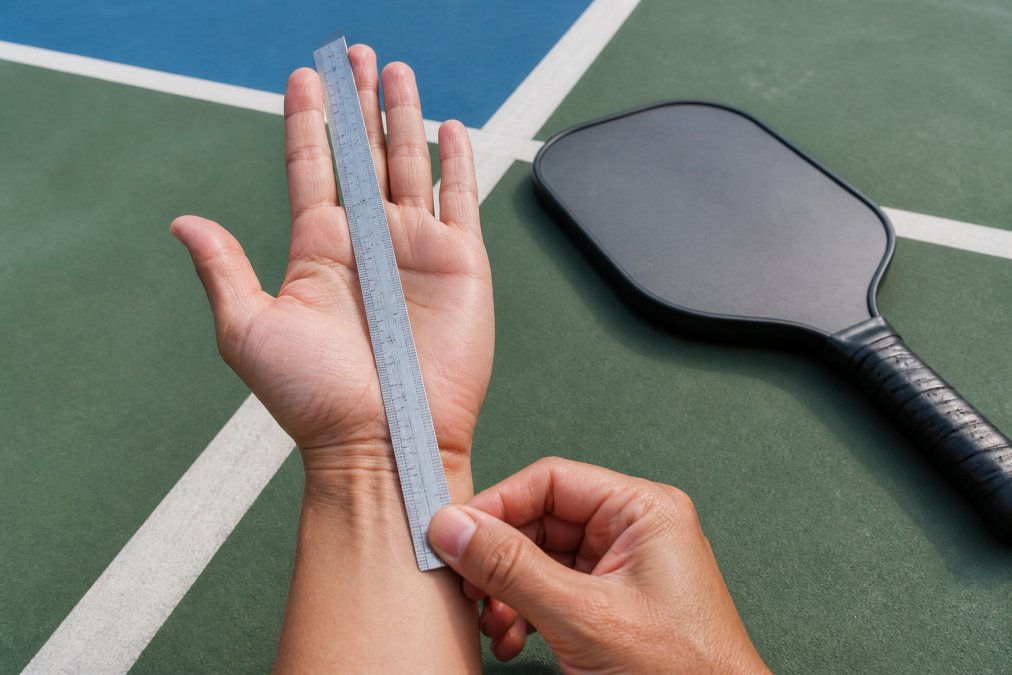
Grab a ruler and place it on a flat surface. Sit with your hand relaxed, palm down, fingers slightly spread. Position the ruler from your wrist crease (where your palm meets your inner forearm) to the tip of your middle finger and write down that measurement.
Small hands typically measure 6.5 to 7.25 inches. Your grip circumference should be roughly 0.5 inches less than your hand length measurement.
Standard grip sizes are:
The Lulla Sport Kids Pickleball Paddle features a 3.75-inch grip circumference, making it ideal for smaller hands. It combines a lightweight design with a carbon fiber face and honeycomb core, delivering durability.
A grip that's too small causes your hand to slide around on the paddle during shots. Your fingers bunch up at the end of the handle with space between them and the base of your palm.
The finger-gap test: If there's a visible gap larger than a pencil width between your index and middle finger and your palm, your grip is too small.
An undersized grip affects shot quality: dinks feel loose, your paddle face tilts unexpectedly, and you compensate by gripping tighter, which fatigues your forearm within a few games.
The wrist stability test: Take a backhand grip and hold the paddle at shoulder height. If your wrist bends or twists to keep the paddle face square, your grip is too small.
When your grip is too small, your hand and forearm muscles work overtime to stabilize the paddle. Over weeks, this leads to tennis elbow (sharp pain on the inside of your elbow) and wrist pain.
A grip that's too large prevents your fingers from wrapping around the handle fully, creating a noticeable gap between your index and middle finger.
The wrap-around test: Your thumb should touch or nearly touch your index finger when you grip normally. If there's a gap of half an inch or more, your grip is too large.
Your hand feels cramped and stretched, and your fingers may feel fatigued or tingly after play.
The palm-contact test: Your entire palm should contact the grip. If only the heel and fingers touch, the handle is too large.
With an oversized grip, you lose feel and precision, your hand tires faster, and dinking becomes difficult because you can't make fine adjustments.
Players with arthritis, carpal tunnel syndrome, or hand-related conditions need special care. A grip that's too small increases joint compression; too large forces an unnatural position.
OUTER SPACE -Lulla Sport Kids →
For players with arthritis: Start with a grip size that matches your hand measurement, then consider adding a cushioned overgrip (0.1875 to 0.25 inches) to absorb shock and reduce joint stress.
For players with carpal tunnel or wrist pain: A slightly larger grip (0.125 to 0.25 inches above your measured size) may help. Work with a physical therapist to determine the optimal size for your condition.
For players with finger joint pain: A cushioned overgrip is often more helpful than changing base grip size, as the padding reduces impact force.
The Lulla Sport Kids Pickleball Paddle ($29.99) features a 3.75-inch grip circumference, lightweight 5.5 oz construction, carbon fiber face, and honeycomb core for stability and consistent shots.
The Miami Lulla Sport Pickleball Paddle ($34.99) offers a 4-inch grip circumference with a resilient fiberglass exterior, polypropylene honeycomb core, specialized edge guard protection, vegan leather handle, and specialized comfort grip band at 7.7 oz.
An overgrip is a thin layer you wrap around the existing grip to adjust feel and size. Overgrips are cheaper, easier to apply, and reversible than replacement grips.
Adding an overgrip increases your paddle's grip circumference. Most standard overgrips range from 0.125 to 0.25 inches in thickness. Here's how to calculate the final grip size:
Formula: Base grip circumference + (2 × overgrip thickness) = New effective grip circumference
The multiplication by 2 matters because the overgrip wraps around the entire handle.
Common overgrip thicknesses are:
For small hands, start with a standard 0.125-inch overgrip unless your base grip is already very close to your target size. Thicker overgrips can overshoot your ideal circumference and create the same problems as an oversized grip, reduced feel, cramping, and loss of maneuverability.
If you're unsure about an overgrip's thickness, you can measure it yourself. Wrap the overgrip around a cylindrical object (like a marker) and use calipers or a digital thickness gauge to measure the wrapped layer. Most sporting goods stores don't stock calipers, but online retailers often provide detailed thickness specs.
Overgrips absorb sweat and wear out faster than base grips. After 20-30 hours of play, they become slick and lose their grip. For players who practice or play 3-4 times per week, plan on replacing your overgrip every 4-6 weeks.
Tennis elbow isn't just for tennis players. Pickleball players get it too, especially when their grip size is wrong.
Your playstyle influences which grip size works best for you.
Use the ruler test: measure from your wrist crease to the tip of your middle finger. For small hands, a measurement of 7 to 8 inches typically indicates you need a smaller grip circumference, usually between 3.75 and 4.25 inches. You can also test by holding a paddle with your fingers; there should be a small gap (about the width of your index finger) between your fingertips and palm when gripping the handle. If your fingers wrap too far around or don't reach properly, the grip size doesn't match your hand.
Look for paddles with grip circumferences between 3.75 and 4.25 inches and shorter handle lengths around 4.75 to 5 inches. The Lulla Sport Kids Pickleball Paddles feature a 3.75-inch grip circumference and 4.75-inch handle, making them ideal for smaller hands. They're lightweight at 5.5 ounces with a carbon fiber face and honeycomb core, providing durability. Adult paddles like the Miami and Monaco models offer a 4-inch grip circumference, suitable if you have slightly larger small hands.
An overgrip adds thickness to your existing grip, which actually makes the handle larger, not smaller. However, overgrips can improve comfort and absorb sweat. If your paddle's base grip is too large, a replacement grip (thinner than the original) is a better solution than an overgrip. Overgrip thickness typically ranges from 0.5 to 1.5 millimeters; multiple layers increase diameter further. For small hands, prioritize finding a paddle with the correct base grip size rather than trying to modify an oversized one.
Yes, significantly. A grip that's too large forces your hand to stretch and work harder, increasing strain on your wrist, forearm muscles, and tendons, which can lead to lateral epicondylitis (tennis elbow). A properly sized grip allows your hand to maintain a neutral position with minimal muscular effort, reducing repetitive stress. For small hands, choosing a smaller grip circumference keeps your wrist in alignment during strokes, distributing force more evenly and lowering injury risk during extended play sessions.
