No Products in the Cart


Last Updated: October 22, 2026
Quick Summary
Wedding thank-you card templates provide structure for personalizing messages to your guests, allowing you to focus on what matters most: acknowledging specific gifts and expressing genuine gratitude. A strong template includes space for a direct thank-you, mention of the specific gift, how you'll use it, and a warm closing statement.
A personalized wedding thank-you card transforms a simple courtesy into genuine gratitude. A hand-addressed envelope mentioning the specific gift makes guests feel appreciated, not like they received a form letter.
Beyond etiquette, they create a tangible keepsake, acknowledge the effort someone took to celebrate and give a gift, and signal that you value the connection.
The challenge is volume: with 50 to 200 guests each deserving a personalized message, the task feels overwhelming. A thoughtful workflow and well-designed wedding thank-you card templates provide structure so you can focus on the personalization that matters.

At Home 2 Court, we've curated beautiful note card options that give your gratitude the presentation it deserves. Whether you choose a blank card or a printable template, the goal is the same: make each guest feel genuinely thanked.
A strong wedding thank-you note follows a simple architecture: open with a genuine thank-you, acknowledge the specific gift, mention how you'll use it, and close with warmth.

Start with directness: "Thank you so much for the beautiful crystal vase." Avoid vague openings like "Thank you for coming to our wedding", lead with what made their contribution special.
Next, personalize with a detail. Name a registry item.
Close with a forward-looking statement that reinforces the relationship.
Tone depends on your relationship with the guest. Formal wording suits older relatives or guests you know less well; casual wording works for close friends and younger relatives.
Formal tone uses complete sentences, avoids contractions, and maintains respectful distance:
Casual tone uses contractions, warmth, and personality:
Most couples blend both. Match the tone to the relationship rather than forcing formality.
Acknowledging cash gifts requires gratitude without seeming transactional. Never mention the exact amount; describe what the gift will enable.
Example for newlyweds: "Thank you so much for your generous gift.
Example for destination wedding: "We're so grateful for your gift and for making the trip to celebrate with us.
Example for close family: "Mom and Dad, your gift is such a blessing.
When thanking for a registry item, name it and describe how you'll use it.
Example for kitchen item: "Thank you for the stand mixer!
Example for home décor: "The throw pillows are absolutely perfect for our living room.
Example for experience or service gift: "Your offer to help us with our move is the best gift we could ask for.
Guests who couldn't attend but sent a gift or card deserve acknowledgment. Thank them for thinking of you and briefly note their absence was felt.
Example: "We missed you at the wedding, but we felt your support from afar.
Example for those sending regrets: "We were sorry you couldn't make it, but we understood. Your kind words and thoughtfulness touched our hearts.
Etiquette suggests sending wedding thank-you cards within three months of the wedding; realistically, aim for six to eight weeks, giving you time to compile your gift list and write thoughtful messages without rushing.

Start immediately after the wedding by creating a master list of all guests who gave gifts, noting what they gave, their address, and special details, your roadmap for personalization.
Begin writing and sending cards within two weeks if possible. If you fall behind, don't let perfectionism stop you, a card sent three months later is still meaningful.
The key distinction: the personal note must be handwritten.
Handwritten cards work best for smaller weddings (under 50 guests) where you have time for full personalization.
Printed cards with handwritten messages are standard for larger weddings. Guests understand the logistics.
Fully printed, pre-written cards are generally not recommended. They feel impersonal, even with a signature. Avoid this approach unless circumstances truly prevent any customization.
Address envelopes by hand whenever possible; if handwriting 150 envelopes feels impossible, printing addresses is acceptable.
Use formal addressing conventions: "Mr. and Mrs. James Mitchell" or "James and Sarah Mitchell," depending on preference.
Inside the card, always personalize with the guest's name.
A personalized salutation combined with a specific message about their gift is the minimum standard for genuine thank-you cards.
Your thank-you card design should coordinate with your wedding aesthetic without matching exactly. Consider your colors, formality level, and overall vibe.
Garden or outdoor weddings suit floral or botanical designs: watercolor florals, pressed flowers, or nature-inspired illustrations.
Destination or adventure weddings pair well with travel-themed or scenic designs.
The design should feel like an extension of your wedding.
Most printable templates allow you to add names, dates, and photos. Use these strategically.
Names and dates anchor the card to your specific wedding.
Photos add warmth but require thoughtfulness. A professional photo looks polished; candid shots feel personal.
Custom details like monograms, initials, or a couple's hashtag add personality.
Start with a template that excites you, then customize gradually, one element at a time.
Paper quality matters more than most people realize. Thick cardstock (100-110 lb) feels substantial and professional. Thin paper feels cheap, even with beautiful design.
Finish options affect how the card feels and looks:
For most weddings, matte or linen finishes are safer choices. They feel more refined than glossy.
Printing options vary by budget and timeline:
Consider finishing touches like foil accents, embossing, or edge painting. These add luxury but increase cost and production time.
Before you write a single card, create a master spreadsheet. List every guest who gave a gift, what they gave, their mailing address, and any personal notes (traveled far, close friend, elderly relative, etc.).
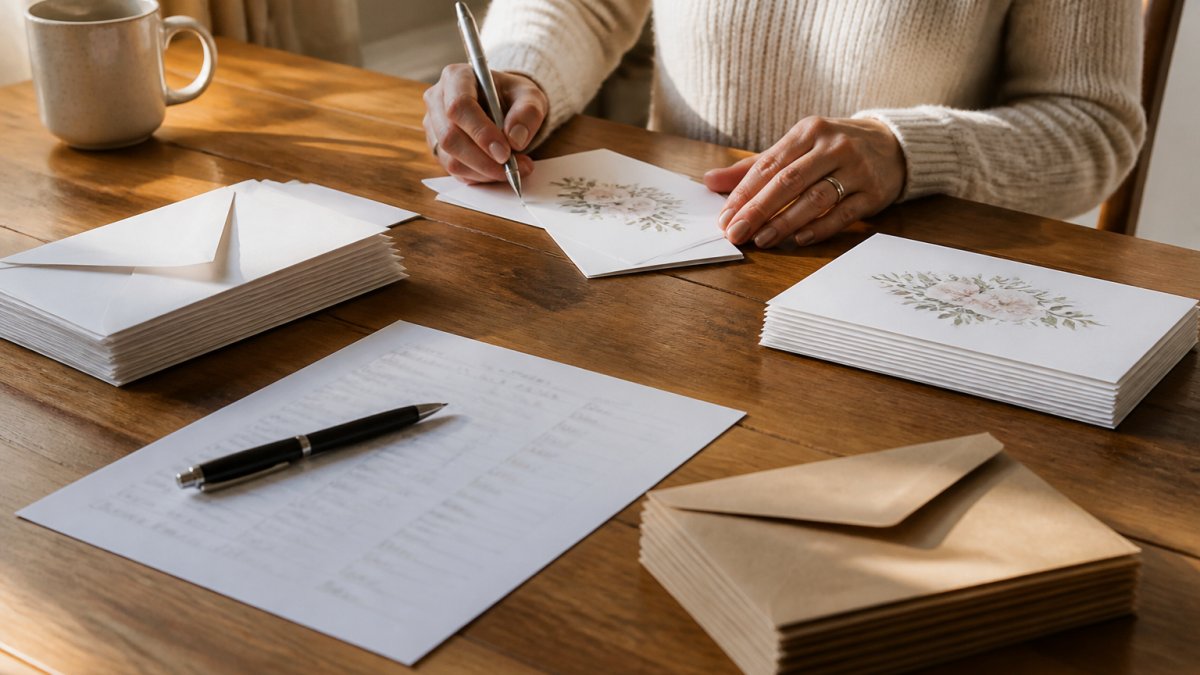
This organization prevents errors like duplicate thank-yous, missed guests, or incorrect addresses. It also helps you batch similar messages, making the writing process more efficient.
Include a column for "card sent" so you can track progress. Seeing your completion rate climb is motivating.
Choose a template that resonates with you. If you're printing at home, download a file you can edit in design software or a template tool.
Add names, dates, and photos as planned. Proofread the design details carefully. Print a test copy if you're printing at home to check color, alignment, and overall appearance.
Order or print your cards. If ordering professionally, do this early, production and shipping can take 1-2 weeks.
Write messages in a separate document first. Draft a few versions for different guest categories (close friends, family, acquaintances).
Personalize each message with the guest's name, their gift, and a specific detail. Proofread for spelling and tone before writing on the card.
If handwriting, use a pen with good ink flow and consistent line width. Black or dark blue ink is standard.
Print or assemble your cards. Address envelopes by hand or print them, depending on your preference and timeline.
Insert the card into the envelope. Add postage. If you're mailing many cards, consider buying postage stamps in bulk or using a postage meter.
Create a mailing schedule. Send cards in batches, perhaps 10-15 per week.
Mail cards promptly after writing them. Delays happen, but aim for consistency.
When multiple people contribute to one gift, address the card to all of them: "Dear Sarah and Michael" or "Dear the Johnson and Mitchell families."
In the message, acknowledge all contributors: "Thank you to both of you for the beautiful serving platter.
If one person is the primary giver and others contributed, you can thank them individually in separate cards, or mention all in one card.
If your thank-you card includes a photo, ensure everyone in it consented to being photographed and agrees to the card's use.
Never use a photo of someone without their permission, even if it's from your wedding. Some guests may not want their image shared.
If you're using a professional wedding photo, confirm the photographer's copyright and usage rights.
Consider that some guests may have vision challenges. Use fonts at least 11-12 point for body text.
Maintain good contrast between text and background. Black text on white or cream background is most readable.
If your design includes photos, ensure text overlays are legible.
These accessibility considerations don't require sacrificing design. They simply mean being thoughtful about how your card communicates.
Sending personalized wedding thank-you cards is one of the final touches that makes your wedding feel complete. Home 2 Court's curated collection of note cards, including elegant options like the FANCY PANTS - Note Card at $7.00 each, provides the beautiful foundation your gratitude deserves.
Start by expressing genuine gratitude for the gift itself. Mention how the couple will use the money, whether toward their honeymoon, home, or shared goals. Example: 'Thank you so much for your generous gift. Your kindness means the world to us, and we're using it toward our honeymoon trip to Costa Rica. We're so grateful to have you in our lives.' Keep the tone warm and personal, and always mention the guest's name to make the message feel genuine.
Etiquette guidelines recommend sending wedding thank-you cards within two to three months of your wedding date. Many couples aim for the three-month window to show timely appreciation without rushing through personalization. If you're running behind, sending a card late is always better than not sending one at all. Start your list early and set a realistic mailing schedule, breaking the task into batches of 10-15 cards per week makes the process manageable and ensures quality personalization.
Begin with a quality template that matches your wedding aesthetic, whether formal, casual, or whimsical. Add the guest's name at the opening, mention the specific gift they gave, and explain how you'll use or enjoy it. Include a personal detail about why their presence mattered, 'Your toast had us laughing all night' or 'We loved catching up at the reception.' Use a blank-interior card like the FANCY PANTS Note Card ($7.00) and handwrite the message for authenticity. Always proofread before finalizing.
Handwritten messages are the gold standard for wedding thank-you cards because they show genuine effort and personal care. Even a printed design with a handwritten message inside strikes the right balance between polish and authenticity.

