No Products in the Cart


Last Updated: September 14, 2026
Modern home decor is a design approach built on clean lines, functional furniture, and a calm, uncluttered layout rather than ornament for its own sake. This guide from Home 2 Court breaks down the principles, palettes, and practical steps that define the look in 2026, so you can apply it room by room without guesswork. The style rewards restraint: fewer pieces, chosen well, arranged with intention.
Two ideas do most of the work. First, form follows function, meaning every piece should earn its place through daily use. Second, negative space is a material in its own right, not leftover emptiness. Get those two right and the rest of the style falls into place.
The National Association of Home Builders design trends research shows that open floor plans remain a dominant preference among buyers, which is one reason modern layouts keep winning. Below, we'll show you exactly how to translate the principles into a room you actually live in.
The defining modern home decor color palettes of 2026 lean on warm neutrals: bone, oatmeal, greige, and soft clay, layered with one or two grounding accents. Pure white walls now read as dated in most rooms. Warmth is the shift.
Cool gray dominated the 2010s because it photographed well and hid dirt. The problem showed up in person: north-facing rooms turned blue, and the palette felt cold after dark. Warm neutrals fix that by carrying a yellow, red, or green undertone that holds up under both daylight and lamp light.
The practical rule is undertone matching. Every neutral has one, and mixing undertones is what makes a room feel off without anyone being able to name why.
Start with two neutrals for walls and large upholstery, then add a third tone for texture and a single accent for punctuation. A monochromatic base with a muted accent reads calmer than a high-contrast scheme.
The 60/25/10/5 split is a starting point, not a rule. The point is that the accent stays small. When the accent creeps past about 10 percent of the visible surface, the room stops reading as modern and starts reading as themed.
Sheen matters as much as color. Flat and matte hide wall imperfections and read softer, which suits the style. Eggshell is the practical compromise for hallways and kids' rooms because it wipes clean. Semi-gloss belongs on trim and doors only, a full semi-gloss wall reflects light in a way that makes a modern room look commercial.
One accent, repeated three times, reads intentional. Three unrelated accents read cluttered. The easiest repeat pattern is a pillow, a piece of art, and one small object on a shelf. If you want a second accent, keep it in the same family, olive and sage, or rust and clay, rather than pulling in a contrasting hue.
Modern minimalist interior design is the practice of removing until only the functional and the meaningful remain, then giving those pieces room to breathe. It is not emptiness for its own sake. A minimalist room with three excellent pieces feels richer than a crowded room with thirty average ones.
Fill roughly 70 percent of your visual space and leave 30 percent open. That ratio keeps a room feeling deliberate instead of sparse. In practice, it means one large anchor per wall, a clear walking path, and surfaces that are mostly bare.
The common mistake is treating minimalism as a shopping list. It is a subtraction exercise. Before buying anything new, remove what you have not used in a year.
Styling a modern living room comes down to six moves, done in order. Sequence matters more than budget, because each step constrains the next.
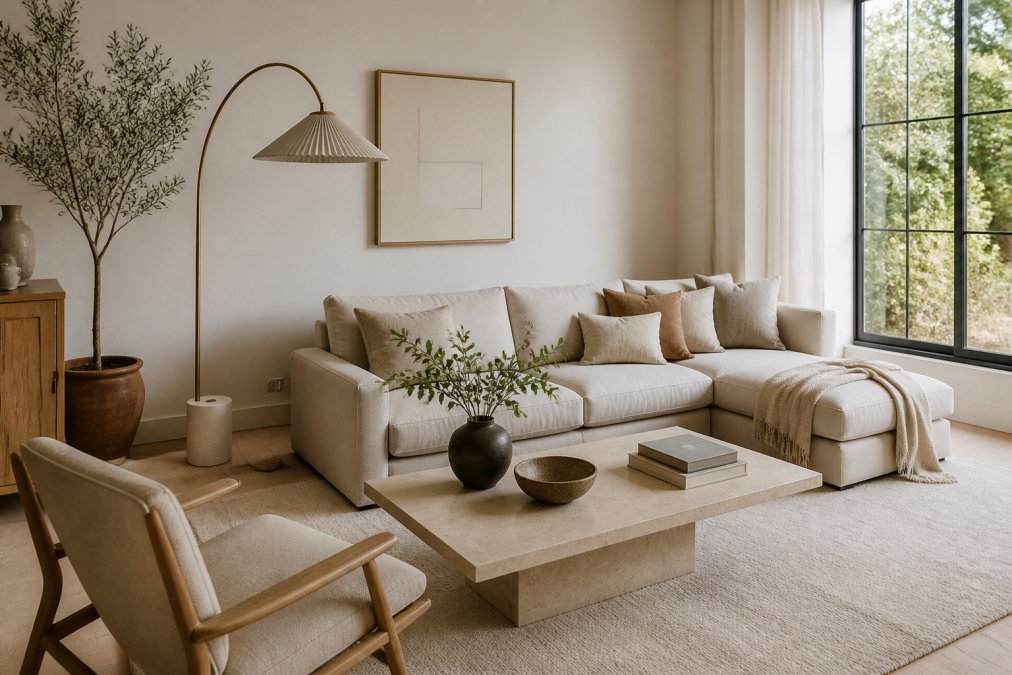
Choose furniture that stores something, folds, or serves two purposes. A bench with hidden storage beats a decorative console. Every piece you add should solve a problem you actually have.
Negative space works the same way in a small room as a large one. Keep at least 18 inches of walking clearance around main seating, and leave one wall mostly bare to give the eye a rest.
You can shift a room toward modern without replacing furniture. The highest-return changes are the ones that touch large visual areas: wall color, lighting, and hardware. Each is inexpensive relative to its impact.
| Upgrade | Typical Cost | Time | Impact |
|---|---|---|---|
| Repaint walls in a warm neutral | Low | One weekend | High |
| Swap cabinet and door hardware | Low | Two hours | Medium |
| Replace builder-grade light fixtures | Medium | One afternoon | High |
| Add a large area rug | Medium | Immediate | High |
| Declutter and restyle shelves | None | One evening | Medium |
Start with the free option. Decluttering costs nothing and changes a room more than most purchases. Then work down the list as budget allows.
Framing is another low-cost lever. A simple high-gloss white frame like the Kendall Frame in white reads clean and modern against a warm wall, and swapping artwork seasonally refreshes a room for the price of a frame. If you want a single piece that lifts a console or side table, a mirrored tray such as the Daphne Narrow Mirrored Tray adds light and reflection without adding visual weight.


Most style guides stop at how a modern room looks. Two things they skip matter more for how it feels to live in: the psychological effect of a low-stimulus layout, and the smart-home hardware that either supports that calm or wrecks it. This section covers both, because they are the same problem.
A modern room reduces visual noise: fewer objects, fewer competing colors, fewer surfaces demanding a decision. The effect is not mystical. When a space has clear sightlines and a small number of focal points, the eye has less to process, and most people report the room feels easier to be in.
The mechanism is consistency. A room that looks the same at 7 a.m. and 9 p.m., minus the light level, feels stable. A room that changes character with every gadget, cable, and blinking indicator light feels restless. That is the trade-off smart home tech has to clear: it adds convenience, and it adds hardware. The goal is to hide the hardware and keep the controls simple.
The rule is one visible control surface per room, maximum. If you have to explain the system to a guest, it is too complicated for daily use.
The U.S. Department of Energy guidance on lighting and energy use notes that lighting controls and efficient fixtures cut both energy use and glare, which matters in rooms built around natural light. Dimming is the single highest-value control in a modern room: it lets one fixture carry morning, evening, and late-night use without adding another visible object.
The psychological benefit of modern decor is mostly subtraction. Removing what you have not used in a year does more for how a room feels than any purchase. A common pattern is that people buy storage to organize clutter they should have removed instead. Empty the surface first, then decide whether it needs anything on it.
Modern decor stays modern longer when you maintain the finishes. The style depends on surfaces looking clean and uninterrupted, so wear shows faster than it does in a busy traditional room. A short routine prevents most of it.
Avoid harsh chemicals on finished surfaces. The U.S. Environmental Protection Agency guidance on safer cleaning products recommends checking product labels before using anything abrasive on coated or sealed finishes, since the wrong cleaner can dull a lacquer or strip a seal in one pass.
Modern rooms fail for one reason: too much stuff, chosen too quickly. The fix is slower and cheaper than most people expect. At Home 2 Court, we stock the finishing pieces that make a modern space feel lived in, including a curated selection of home decor and gifts, bridal gift and registry services, and specialized pickleball equipment for the rec room or the court. Start with one room, add pieces you will still like in five years, and let the space stay uncluttered. Get started with Home 2 Court and build a home that works for both quiet evenings and full-house weekends.
The 3-5-7 rule is a guideline for arranging accessories in odd-numbered groups to create visual balance. For example, place three items on a coffee table, five on a bookshelf, and seven on a mantel. This technique works well with modern home decor because it adds interest without clutter. Vary heights and textures within each group to keep the arrangement dynamic and aligned with clean lines and negative space.
The 70/30 rule suggests that 70% of your space should follow a dominant style or color, while 30% can introduce contrast or accent pieces. In modern minimalist interior design, this often means 70% neutral tones like white or gray, and 30% bold accents such as a statement chair or geometric art. This balance prevents a room from feeling monotonous or overwhelming, and it helps maintain a cohesive look.
Modern decor refers to a specific design movement from the mid-20th century, characterized by clean lines, neutral color palettes, and functional furniture. Contemporary design, on the other hand, reflects current trends and can change over time. While both value simplicity, modern style often incorporates iconic pieces like Eames chairs and flat roofs, whereas contemporary may include curved shapes and mixed materials. Understanding this distinction helps you choose pieces that fit your intended aesthetic.
In small spaces, focus on scale and multi-functional furniture. Choose a loveseat instead of a full-size sofa, and use a wall-mounted desk or floating shelves to save floor space. Mirrors, like the Daphne Mirror from Home 2 Court, can make a room feel larger by reflecting light. Keep the color palette light and monochromatic, and avoid heavy curtains. Emphasize vertical storage and decluttering to maintain an open, airy feel.
Modern home decor color palettes typically revolve around neutrals: white, gray, beige, and black, often with a single bold accent like navy or mustard. In 2026, expect to see warmer neutrals like taupe and soft brown, paired with metallic finishes. Monochromatic schemes with varying textures are also popular. These palettes create a calm, uncluttered backdrop that lets architectural elements and statement lighting stand out.
To blend modern decor with existing furniture, start by decluttering and removing pieces that feel too ornate. Keep items with clean lines and neutral colors. Add modern accents like a geometric area rug, sleek table lamps, or a minimalist picture frame. Balance old and new by grouping items by color or material. For example, pair a traditional wooden table with modern chairs. The key is to edit carefully so the overall look feels cohesive and uncluttered.
