No Products in the Cart


Last Updated: October 15, 2026
The honest answer to whether professional pickleball gear is worth it depends almost entirely on how often you play and how fast you want to improve. At Home 2 Court, we see two very different shoppers: weekend players who need reliable gear that lasts, and competitive players chasing spin, control, and consistency. Both groups can overspend. The question isn't whether premium equipment is good.
Professional pickleball gear is equipment designed for players who compete regularly and need measurable performance gains in spin, control, and durability. For a recreational player logging one game a month, that engineering rarely shows up in the score. For someone playing three times a week and drilling specific shots, it shows up fast.
That's the throughline of this guide. Skill level and playing frequency, not price tags, should drive every gear decision you make.
A high-end pickleball paddle earns its price when it fixes a specific problem in your game. If you're struggling with third shot drops that pop up, a control-focused paddle with a raw carbon face and a softer core can change your trajectory. If your hands are slow at the net, a lighter paddle with a larger sweet spot helps more than raw power ever will.

When it isn't worth it: when you can't yet feel the difference. Beginners still building consistent contact won't notice the gap between a $35 paddle and a $200 one. The money is better spent on court time.
The paddles professionals use share a few traits: carbon-based construction, a large sweet spot, and a grip tuned to their hand size. But here's what most guides miss. Pros don't win because of the paddle. They win because the paddle matches their playing style, and they've logged hundreds of hours with it.
Pickleball paddles pros use typically fall into two camps: control paddles for dinking and resetting, and power paddles for driving and finishing. Neither is "better." A pro with a control paddle beats a pro with a power paddle if the matchup rewards patience.
For players who want that same level of control, the Vanguard Control Epic Midweight Raw Carbon at $199.99 is built around a T700 Raw QuadCarbon Fiber face and an X5+ 16mm polypropylene honeycomb core. That combination is engineered for spin and consistency, not brute force.
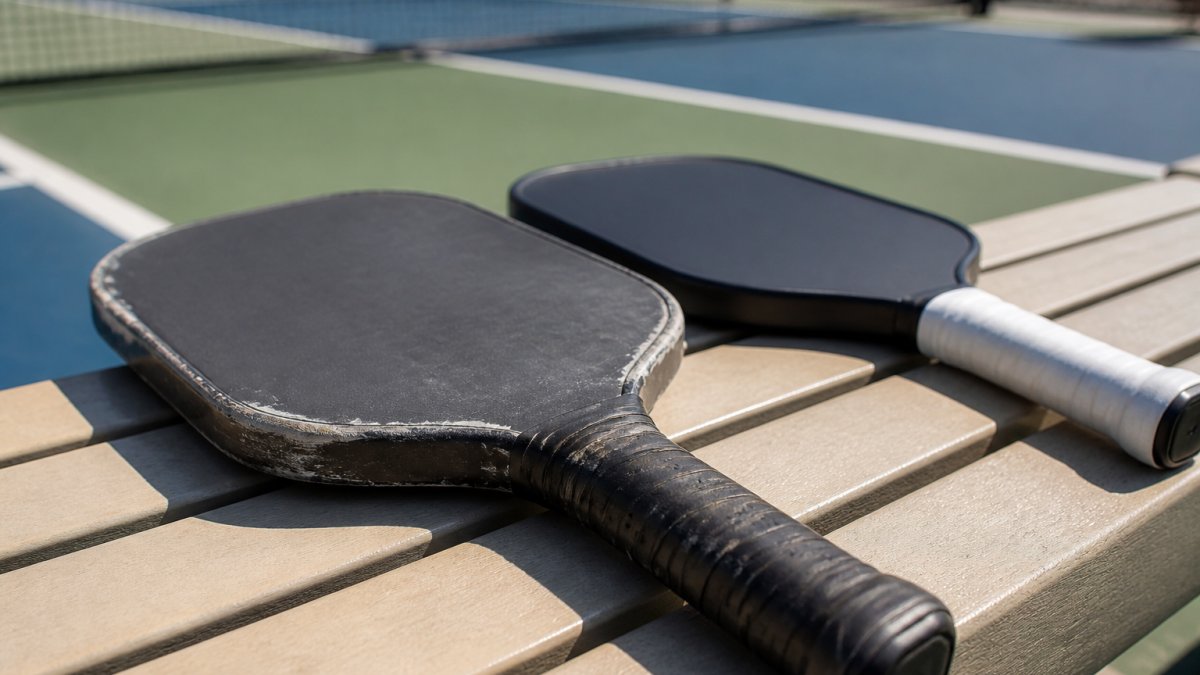
Durability is where the "is it worth it" question gets concrete. A paddle's useful life is a function of three variables: how often you play, how hard you hit, and how well you care for the face and edge. A recreational player logging one session a week can reasonably expect two to three years from a quality paddle. A competitive player drilling three or more times a week, hitting hard drives, and playing on abrasive outdoor surfaces may see meaningful performance loss in six to twelve months.
Hold the paddle by the handle and tap the face lightly with a finger or a ball across a grid of points. A healthy paddle produces a consistent, ringing tone. A dull thud in one area signals a dead spot. Repeat monthly. This is the same principle behind the tap test many players use before buying a used paddle.
| Playing frequency | Typical replacement window |
|---|---|
| 1x per week, recreational | 2-3 years |
| 2-3x per week | 12-18 months |
| 4+ times per week or tournament play | 6-12 months |
These are patterns, not guarantees. Surface, technique, and storage all shift the window.
If you play tournaments, a worn paddle isn't just a performance issue, it can be a rules issue. USA Pickleball maintains the official equipment standards and publishes a list of approved paddles. Before you buy, confirm the model appears on that list. A paddle that's delaminated, has a modified surface, or falls outside the approved specifications can be disallowed at check-in. For competitive players, checking approval status is part of the buying decision, not an afterthought.
Grip tape is cheap and easy to replace, do it every few weeks of regular play. Edge guard damage and core dead spots are not user-serviceable. Once the face texture is gone or the core is compromised, you're paying for a paddle that no longer delivers the spin and control you bought it for. That's the real durability calculation: not how long the paddle survives, but how long it performs at the level you paid for.
Most buying guides stop at the paddle. That's a mistake. Essential pickleball equipment includes everything that touches your game, and the paddle is only one piece of the puzzle.
| Gear Item | What It Does | When to Upgrade |
|---|---|---|
| Paddle | Spin, control, power | When technique is consistent |
| Balls | Bounce and durability | When play frequency rises |
| Court shoes | Grip and ankle support | Immediately, before anything else |
| Grip tape | Hand feel and shock absorption | Every few weeks of play |
| Eyewear | Protection from stray balls | From your first game |
Balls matter more than most players admit. The Diadem Premier Power Pickleball Ball at $15.00 per 3-pack is USAPA approved, with a high-visibility yellow finish that holds up during fast rallies. For casual players who want a lighter, style-forward option, the Miami Lulla Sport Pickleball Paddle at $34.99 pairs a fiberglass exterior with a polypropylene honeycomb core and a vegan leather handle.
Vanguard Control Epic Midweight Raw Carbon →


Cost per use is the only gear calculation that matters, and most guides skip it. Divide the price by the number of sessions you'll actually play before the gear needs replacing. That last part, the replacement cycle, is what changes the answer.
A $199.99 paddle used twice a week for a year is 104 sessions, or about $1.92 per session. But that paddle may need replacing after 12-18 months of that pace. Spread over 18 months at 104 sessions per year, that's 156 sessions and about $1.28 per session.
A $34.99 paddle used once a month for a year is 12 sessions, or about $2.92 per session. If it lasts two years at that pace, it drops to roughly $1.46 per session, but it won't deliver the same spin, control, or consistency, and it may fail sooner under harder use.
The lesson: the premium paddle wins on cost per use only when you play often enough to amortize it. Frequency, not price, drives the math.
Professional gear is a system. Budget for the whole kit, because the paddle is rarely the item that most affects your game or your body.
| Gear item | Typical price range | Replacement cycle |
|---|---|---|
| Paddle | $35-$250 | 6-36 months by frequency |
| Balls (3-pack) | $10-$20 | Weeks to months |
| Court shoes | $60-$150 | 6-12 months of regular play |
| Grip tape | $5-$15 | Every few weeks |
| Eyewear | $15-$60 | As needed |
Shoes are the most underrated line item. Court-specific shoes provide lateral support and grip that running shoes don't, and they wear out faster than most players expect. For anyone playing more than once a week, shoes deliver more injury-prevention value per dollar than a paddle upgrade.
Professional gear is worth it when three things are true: you play often enough to amortize the cost, your technique is stable enough to feel the difference, and the gear matches your style. When any of those is missing, the premium price buys prestige, not performance. Run the math for your own frequency, then let the numbers, not the marketing, make the call.
The gear debate isn't really about price. It's about fit. Players who match equipment to their skill level, playing frequency, and competitive goals get more out of every dollar. Players who buy based on hype end up with a paddle that outclasses their game.
At Home 2 Court, we curate pickleball equipment for every stage of play, from entry-level paddles to elite raw carbon control models, alongside the apparel and lifestyle pieces that make time on the court feel like part of a balanced life. Browse our collection, and let your playing style, not the price tag, make the call.
It depends on how often you play and your goals. A premium paddle like the Selkirk VANGUARD Control at $199.99 offers raw carbon spin, a larger sweet spot, and vibration absorption that helps with consistency. If you play several times a week or compete, that upgrade can pay off. If you play casually once a month, a recreational paddle under $50 covers the basics.
Pros typically choose raw carbon fiber faces paired with polypropylene honeycomb cores, like the Selkirk VANGUARD Control series. These materials deliver spin, control, and a softer feel for third shot drops and resets. Weight matters too: midweight (around 7.7 oz) suits power players, while lightweight versions favor quick hands at the net. Grip size and handle length also factor into pro paddle choice.
With regular play, a pickleball paddle durability window runs about six months to two years. The face texture that generates spin wears down first, and the core can soften or crack from repeated impact. Players who log 10+ hours a week often replace their paddle annually. Keeping it in a cover and avoiding extreme heat extends the replacement cycle.
Start with a paddle, indoor and outdoor balls (a 3-pack like the Diadem Premier Power runs $15.00), court shoes with lateral support, and a water bottle. A small bag keeps it all together. As you improve, add a spare paddle, grip tape, and moisture-wicking apparel. Most beginners can cover the basics for under $100, then upgrade gear as their game grows.
Every player eventually hits the wall where their current gear stops keeping up with their game. That moment is different for everyone. If you're ready to move up, Home 2 Court carries specialized pickleball equipment for all skill levels, plus curated home and lifestyle pieces for the moments between matches. Get started with Home 2 Court and find gear that fits the way you actually play.
