No Products in the Cart


Last Updated: October 12, 2026
Mixing decor styles means blending two or more design styles in one room so the result feels collected rather than catalog-bought.
Most rooms fail for one reason: no single style leads. When everything shouts equally, nothing lands.
Below, we'll show you how to mix decor styles at home using a repeatable five-step process.
The fix is not buying more. It is deciding what leads and what supports.
You need two things before moving a single piece of furniture: an inspiration board and a clear primary style. Skipping this step is why most attempts stall halfway.
An inspiration board is a collection of images that share a common look, not a wish list of everything you like.
Gather 15 to 20 images from magazines, saved posts, or Pinterest, then look for repeats.
If your images share a theme, you have your direction. If they clash, sort them into two piles and pick the larger one.
Your primary style fills most of the room; your secondary style adds contrast and interest.
Common pairings that work well:
Write both down. This becomes your filter for every purchase and placement decision.
Pick one style to lead at roughly 80 percent of the room, and let the second take the remaining 20 percent.
Ask yourself: if a guest walked in, what would they say the room is?
A practical test: count your major pieces, sofa, rug, main table, large art.
The secondary style should show up in accents, not anchors: a lamp, a jar, a throw, a side table.

The 80/20 rule means roughly 80 percent of your room follows the primary style and 20 percent breaks from it, keeping the space cohesive while still layered.
Here is how that breaks down in a typical living room:
| Element | Primary Style (80%) | Secondary Style (20%) |
|---|---|---|
| Seating | Main sofa and chairs | One accent chair |
| Tables | Coffee table | One side table |
| Textiles | Rug, main curtains | Throw pillows, one blanket |
| Decor | Wall art, shelving | Lamp, vase, small objects |
Notice the secondary style never dominates a category, it shows up once per group. That restraint makes the mix look deliberate.
If a room feels flat, add one more secondary piece. If it feels busy, remove one. Small adjustments beat full redesigns.
Different rooms need different approaches. A living room can carry more contrast than a bedroom, and small spaces need tighter rules than large ones. The principles stay the same, but proportions, materials, and focal points shift by room.
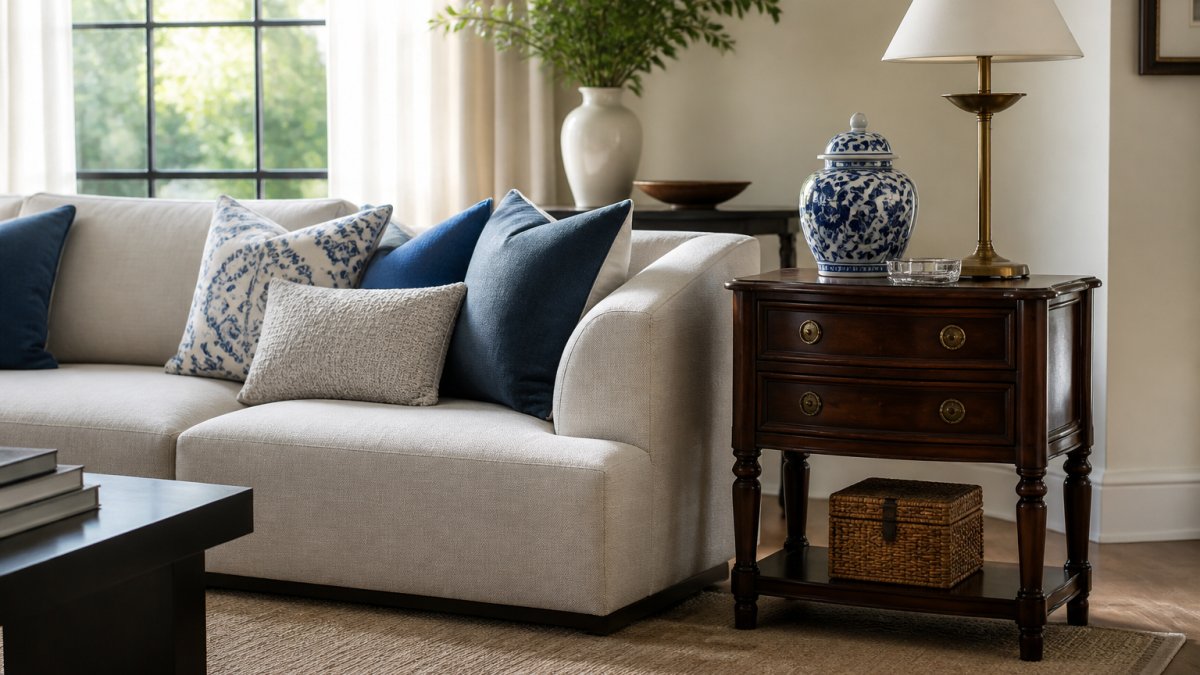
A modern sofa with clean lines pairs well with one traditional wooden piece. The contrast reads as collected, not mismatched.
Our Indra Side Table blends white marble and brass in a petite 23.5-inch design. A Blue Chinoiserie Ginger Jar brings old-world character to a modern corner without fighting the furniture.

Trade-off: traditional wood pieces are visually heavier. If your sofa is light-colored and low, a dark wood side table can feel like it is sinking the corner.
Keep the bed and large furniture minimalist. Add bohemian texture through textiles: a woven throw, a patterned pillow, a soft rug.
The rule is texture over pattern. Minimalist lines plus too many prints turn messy fast.
Scale note: the bed is the dominant mass in a bedroom.
Kitchens are the hardest room to mix because cabinetry and appliances are fixed. Work with what is permanent rather than against it.
A workable kitchen ratio: 90 percent primary, 10 percent secondary.
For dining rooms, the table sets the tone. Choose it in your primary style, then let chairs or a sideboard carry the secondary style.
Open-plan rooms fail when each zone has its own palette and style. The fix is a shared throughline: one color, one material, or one repeated shape in every zone.
Layout tip: use furniture backs and rug edges to define zones rather than walls. A sofa with its back to the dining area creates a boundary without blocking light.
Indra Side Table - Napa Home and Garden →
Small rooms and rentals need the tightest version of the 80/20 rule. Pick a primary style, then add just two or three secondary pieces.
Our MDF and Acacia Wood Lacquered Folding Table in sage folds flat for storage and moves room to room. That flexibility matters when you cannot change the walls.
| Room | Primary Style | Secondary Style | Watch For |
|---|---|---|---|
| Living room | 80% | 20% | Competing focal points |
| Bedroom | 85% | 15% | Secondary pieces taller than the nightstand |
| Kitchen | 90% | 10% | Fighting fixed cabinetry |
| Dining room | 80% | 20% | Too many chair styles |
| Open plan | 80% per zone | 20% per zone | Zone palettes drifting apart |
| Small space or rental | 85% | 15% | Accents in every corner |
These are starting points, not rules. Adjust one piece at a time and judge the room from the doorway, where the whole composition reads at once.
Mixing patterns works when you vary scale, not quantity. Use one large pattern, one medium, and one small, all in the same color family.
A safe formula for beginners:
Keep all patterns within two or three colors. That shared palette makes bold prints feel calm instead of loud.
A reliable starting point is 60 percent solid, 30 percent medium pattern, 10 percent large pattern. In a living room, that means a solid sofa, a medium-patterned rug, and one large-patterned pillow or piece of art.
Want more pattern? Shift to 50/30/20. If the room feels busy, pull back to 70/20/10. Move in 10-point steps rather than swapping everything at once.
Different pattern families carry different style signals. Knowing which is which keeps the mix intentional:
When you mix a modern primary with a traditional secondary, choose a geometric in the primary and a small floral in the secondary. The pattern types reinforce the style split instead of blurring it.
Patterns clash most often because their scales are too close. Two medium prints side by side compete; a large and a small print cooperate.
A simple test: squint at the arrangement. If the two patterns blur into the same texture, their scales are too similar.
Also match pattern scale to object size.
If two patterns compete, separate them. Put a solid cushion or plain surface between them, distance reduces friction.
Other fixes that work:
A cohesive interior design comes from two things: a shared color palette and connecting materials. Get those right and almost any style pairing holds together.
Pick three colors: one dominant, one secondary, one accent. Repeat them in every zone of the room.
A neutral base makes mixing easy. White, cream, or warm gray lets both styles sit together without clashing.
Pull your accent color from something you already own. A blue jar, a gold lamp, a sage table.
Materials are the quiet glue in a mixed room. If two styles share a material, they read as related.
Look for overlaps:
Our Bamboo Lamp Base in a gold finish is a good example. The gold tone ties to brass accents elsewhere, while the slim shape suits a modern table.

The biggest mistake is giving both styles equal weight. A room with no clear leader feels unsettled, and no amount of rearranging fixes it.
Other traps we see often:
Fix the first one and the rest get easier. Decide what leads, then let everything else follow.
The challenge with mixing styles is not taste. It is restraint. Rooms that work follow a clear leader, a tight palette, and a few deliberate contrasts.
That is where we come in.
Get started with Home 2 Court and create a home that feels collected, comfortable, and entirely yours.
The 3-5-7 rule is a styling guideline for arranging accessories in odd-numbered groups: three items, then five, then seven, with varying heights and shapes. The idea is that odd numbers feel less static than even ones, so a shelf or coffee table looks collected rather than staged. It pairs well with mixing decor styles because you can group a traditional ginger jar, a modern candle holder, and a textured vase in one arrangement without any single piece dominating.
Yes. Mixing interior design styles is one of the fastest ways to make a room feel personal rather than showroom-catalog. The trick is to pick one primary style that covers roughly 80 percent of the room and let a secondary style fill the rest. When you mix decor styles with a clear dominant direction, the result reads as intentional. Without a dominant style, the same pieces can look like a collection of unrelated purchases.
Two styles per room is the practical limit for most people. A third style works only if it shows up in small doses, such as a single accent chair or a piece of art, and if all three share a common thread like a color, a metal finish, or a natural material. Beyond three, the room starts to lose a design throughline and the eye has nowhere to rest.
Anchor the room with the style you have more of, then add the contrasting style in one or two deliberate spots. A traditional wood console with a modern marble side table, or a modern sofa with a traditional rug, gives you contrast without clutter. Keep the color palette tight, repeat one material such as brass or natural wood in both styles, and leave open space around each piece so the contrast reads as a choice.
