How to Host a Pickleball Tournament Party: 2026 Guide

by Editorial Team on September 04, 2026

Table of Contents

Last Updated: September 5, 2026

Hosting a pickleball tournament party turns a casual Saturday into a day people talk about for weeks. Whether you have two courts or a driveway with a portable net, the key is structure: planning the flow so every guest gets plenty of play, feels included, and stays fed and hydrated.

Pick the Right Format: Round Robin vs. Bracket

The most important decision is how to structure the play. A round robin guarantees everyone plays multiple games against different opponents, making it the best choice for social play and mixed skill levels. A single-elimination bracket is more competitive and finishes faster, but losing players sit out for the rest of the event.

For more than eight players or a group with beginners, choose the round robin. For a smaller group of experienced players who want a clear winner, a bracket format delivers the tension of a final matchup.

A hybrid approach also works well: use a round robin for the first hour to seed players, then run a short bracket for the top finishers.

How to Run a Round Robin Pickleball Tournament

Running a round robin is about managing court rotation and tracking scores efficiently. For eight players on two courts, run doubles matches where partners rotate each game. Play games to 11 points, win by 2, keeping each game to roughly 15-20 minutes.

Create a rotation sheet before the event listing each player’s name down the left and game numbers across the top, assigning partners so no one plays the same partner twice until necessary. Track wins and losses to rank players at the end.

Keep a clipboard or tablet with a shared spreadsheet handy. Assign one non-playing guest as the scorekeeper to avoid disputes and slowdowns.

Pickleball Tournament Bracket Templates and Digital Tools

For a party, the real bottleneck is scorekeeping and communication, not drawing the bracket. Use a digital tool that handles real-time scoring and lets guests check the next matchup from their phones.

Challonge (challonge.com)

Challonge is a free option for a double-elimination or hybrid bracket. It's not pickleball-specific, but it handles the math for you.

  • Setup: Create a tournament, choose "Double Elimination" or "Single Elimination," and enter player names. For a party, use the "Randomize seeds" option to avoid arguments about rankings.
  • During play: Open the site on your phone. When a match ends, tap the winner's name, and the bracket automatically advances them.
  • Sharing: Enable the public page link and share it in your group chat before the event. Guests can refresh the page on their own phones to see the updated bracket without asking you.
  • The catch: It's not built for round robins with rotating partners. Use it only for the bracket portion of a hybrid format.

Pickleball Brackets (pickleballbrackets.com)

This is a pickleball-specific platform designed for club play, but it has a free "Social" mode that works for a party.

  • Setup: Create an event, select "Round Robin," and enter your player list. The system generates a full rotation schedule, ensuring no one plays the same partner or opponent twice until necessary.
  • During play: The app tracks scores in real time. You can assign a non-playing guest as the scorekeeper, and they can enter results from a tablet at the court.
  • The catch: The interface is more cluttered than Challonge, and the free tier limits you to one event at a time. It's worth it only if you're running a pure round robin and want the rotation math done for you.

The Low-Tech Backup

Digital tools fail when your phone dies or the Wi-Fi drops. Always print a one-page bracket or rotation sheet as a backup and post it on a clipboard at the net post.

A Practical Setup for a Party

Here's the workflow for a group of 8-12 players on two courts:

  1. Before the event: Create the bracket or round robin schedule digitally. Share the link in your invitation so guests can see the format ahead of time.
  2. At the start: Announce that scores will be updated on the shared link. Assign one person (not you) to be the official scorekeeper. This is a great role for a guest who is injured or prefers to watch.
  3. During play: The scorekeeper enters results immediately after each match. You focus on court flow, food timing, and keeping the energy up.
  4. At the end: The digital tool automatically calculates standings. You don't need to tally wins and losses by hand.
Pro Tip For a hybrid format (round robin followed by a bracket), use Pickleball Brackets for the round robin portion to generate the rotation, then export the top four finishers into a Challonge single-elimination bracket for the finals. This takes about 5 minutes and gives you the best of both tools.

Why This Beats a Whiteboard

A whiteboard works for a group of four; for eight or more, it becomes a bottleneck. A digital bracket eliminates the crowding and erasing and frees you up to host the party.

Court Setup and Equipment Checklist

Marking lines and bringing extra balls is table stakes. What separates a smooth event from a chaotic one is a plan for the two things that ruin outdoor pickleball parties: weather and equipment failure.

The Weather Contingency Plan (Before You Send Invitations)

If you're hosting outdoors, you need a Plan B before the sun is out:

  • Check the forecast 48 hours out. If there's more than a 40% chance of rain or the heat index is projected above 95°F, activate your backup plan (the CDC). Don't wait until the morning of the event.
  • Identify an indoor backup venue. Options include a local community center, a church gymnasium, or a tennis club with indoor pickleball lines. Call ahead to check availability and hourly rates. Have this booked as a tentative hold if the forecast looks risky.
  • Set a rain date. Pick a specific Saturday two weeks out. Tell guests in the invitation: "If it rains, we move to the rain date of [date]." This removes ambiguity and prevents no-shows.
  • For extreme heat: Move the tournament to the morning (start at 8 AM instead of 10 AM), add a second shade canopy over the seating area, and set up a misting fan near the hydration station. Schedule a 10-minute water break every 45 minutes of play.
  • For sudden rain: Have a large tarp and bungee cords in your car. If a storm rolls in mid-game, cover the net and any electronics, move food under a canopy, and pivot to indoor games (like a pickleball trivia quiz or a paddle skills contest) until it passes.
Watch Out Do not play on wet courts. Pickleball courts become dangerously slippery when wet, and the risk of ankle injuries spikes ([peer-reviewed research](https://pmc.ncbi.nlm.nih.gov/articles/PMC2577485/)). If the court surface is visibly damp, stop play immediately and switch to your backup plan.

The Equipment Checklist That Actually Matters

Beyond the basics, here's what you need to avoid mid-event failures:

SHOP NOW! →

  • Paddles: Ask guests to bring their own if they have them. For beginners, have 4-6 loaner paddles available. A mid-range composite paddle (in the $40-$60 range) is a better loaner because it gives beginners a fair chance to actually enjoy the game (usapickleball.org).
  • Balls: Outdoor pickleballs are not all the same. The Franklin X-40 is the standard for outdoor play and is widely available. Bring at least one new tube of balls per court. Old balls lose their bounce and behave erratically. Have a few extras in your pocket for when one rolls into a storm drain or gets crushed by a chair.
  • Net tension: If you're using a portable net, check the tension before guests arrive. A sagging net changes the bounce and leads to arguments about whether a ball was in or out. Most portable nets have a crank or strap system; tighten it 30 minutes before play starts.
  • Court lines: For a driveway or backyard setup, use chalk tape (not regular painter's tape) for the lines. Chalk tape is wider, more visible, and doesn't leave sticky residue. Mark the kitchen line (7 feet from the net) clearly, as this is the most common source of rule disputes.
  • First-aid kit: Include bandages, antiseptic wipes, and instant ice packs. Scraped knees from a dive for a dink are common. Also bring sunscreen and bug spray, and place them on the check-in table so guests can help themselves.
  • The spare-paddle station: Set up a small table near the court with loaner paddles, extra balls, and a towel. This keeps everything in one place and prevents guests from wandering into your garage mid-event.

The 15-Minute Setup Sequence

Here's the order that works when you arrive at the venue:

  1. Net first (5 minutes): Set up and tension the net. This is the most time-consuming piece.
  2. Court lines (5 minutes): Lay down chalk tape. Do this after the net is up so you can measure from the net center.
  3. Hydration and shade (5 minutes): Set up the water station and shade canopy. This is more important than the decor.
  4. Equipment table (last): Put out loaner paddles, extra balls, and the first-aid kit.

This sequence ensures the court is playable first, and everything else is secondary. If you run out of time, guests can start warming up while you finish the peripheral setup.

Pickleball Party Food Ideas for Your Tournament

Food should be portable, easy to eat between games, and served at the right temperature. Finger foods like sliders, veggie trays, and fruit skewers work well because players can grab a bite without sitting down for a full meal. For a festive touch, serve drinks in reusable party cups with pickleball-themed designs, like the Santa Barbara Design Studio frost cup sets available through Home 2 Court, which add a playful vibe and hold up to outdoor use.

Santa Barbara Design Studio Reusable Plastic Party Cup Pack Frost Flex Cups, 8-Count/16-Ounce

Cold foods stay fresher longer with the right serving setup. A Party Platter On Ice serving set keeps chilled items like shrimp cocktail or a cheese platter at a safe temperature without constant refilling. Use the vented upper tray so the cold air circulates and the food stays crisp.

For plates, opt for durable melamine sets in bright colors that echo the pickleball court, like the Pickleball 6" melamine plate set from Supreme Housewares. They’re break and scratch resistant, which makes them ideal for outdoor events where plastic disposables would blow away. Set up a hydration station with water and sports drinks, and remind players to drink between games, not just at the end.

Themed Decor, Prizes, and Party Atmosphere

The atmosphere separates a game from a party. Choose a color scheme that echoes the court, bright greens, yellows, and reds, and carry it through tableware, napkins, and balloons. String lights or pennant flags add a festive feel without getting in the way of play.
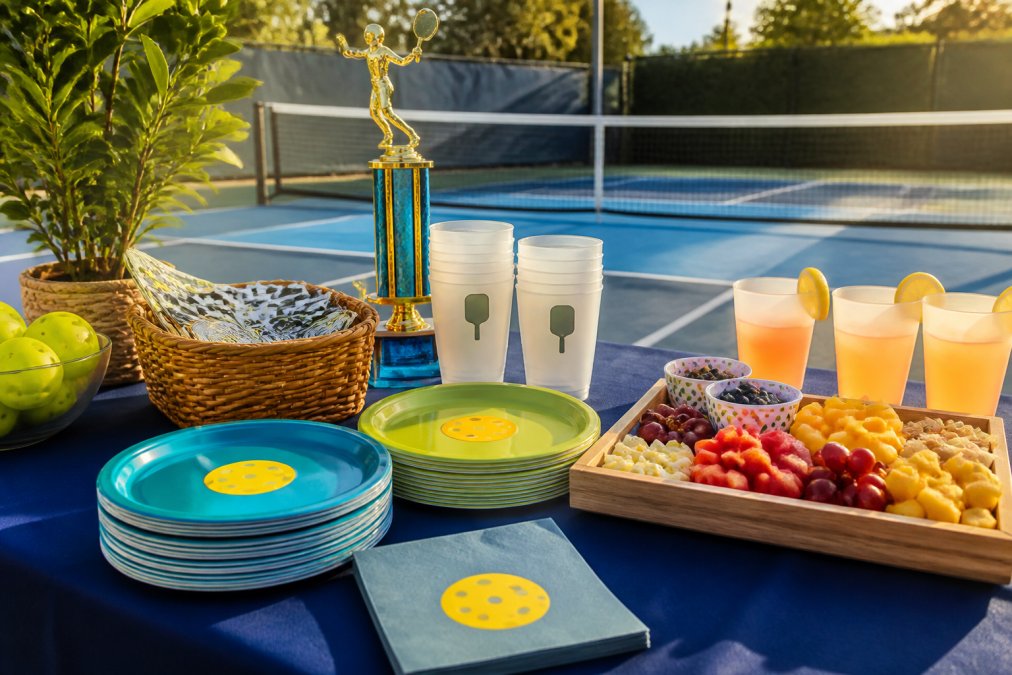
A vibrant outdoor pickleball party setup with colorful melamine plates, frosted plastic cups, and a pickleball net visible in the background under late afternoon sun

Prizes don’t need to be expensive. A small trophy or a gift bag with a new paddle gives winners something to show off. For “most spirited player” or “best dink of the day,” hand out a fun consolation prize like a custom koozie or a gift card.

Background music at a moderate volume keeps energy up without interfering with calls. Create a playlist ahead of time with upbeat, non-distracting tracks. Designate a shaded seating area where players can rest and watch the next matchup.

Your Pickleball Tournament Party Timeline

A clear timeline keeps the event running smoothly and prevents games dragging on while guests get hungry. Here’s a proven schedule for a half-day event:

  1. Setup (60 minutes before guests arrive): Mark courts, set up tables, arrange food and drinks, and test the sound system.
  2. Guest arrival and warm-up (first 30 minutes): Welcome everyone, hand out name tags, and let players hit a few balls to warm up.
  3. Tournament play (next 2 hours): Run your round robin or bracket with games to 11 points. Announce the schedule for court assignments clearly.
  4. Break for food (30 minutes): Pause play so everyone eats together. This is a natural point to catch up and build the social atmosphere.
  5. Finals and awards (final 45 minutes): Play the championship game, then hand out prizes and take a group photo.
  6. Wrap-up (last 30 minutes): Announce the final results, thank guests, and start cleanup while people linger.

Build in 10-15 minutes of buffer between the tournament and finals in case games run long. The break after the main round robin works best because it gives you time to calculate standings and set up the finals.

Watch Out Skipping a weather contingency plan can ruin an outdoor event. If rain is in the forecast, identify an indoor backup venue or a covered court option before you send invitations, and have a clear rain date in mind.

Conclusion: Ready to Host Your Pickleball Tournament Party

Hosting a successful pickleball tournament party comes down to preparation: choosing the right format, setting up courts properly, and planning food and a timeline that keeps everyone engaged. The event should feel organized but not rigid, structured enough for fair play, flexible enough for fun.

For the tableware, serving pieces, and pickleball gear that make your party look intentional and polished, Home 2 Court offers a curated selection designed for hosts who care about the details. From frost cups and melamine plates to paddles for every skill level, you’ll find everything you need to create a welcoming space for friendly competition. Get started with Home 2 Court and make your next gathering a memorable one.

Frequently Asked Questions

What kind of food should I serve at a pickleball party?

Serve easy-to-eat finger foods that don't require utensils, so players can grab a bite between matches. Think sliders, fruit skewers, veggie trays, and chips with dip. Keep cold items chilled on ice to stay fresh outdoors. Avoid messy foods that could stain clothing or court surfaces.

How do you organize a pickleball tournament bracket for a party?

Start by grouping players by skill level so matches stay close and fun. For a social party, use a round robin format where everyone plays several short games. You can find free pickleball tournament bracket templates online or use apps to manage the schedule. Write the bracket on a large poster board for everyone to see. Keep games short, like first to 11 points, to keep the party moving.

How many courts do you need for a pickleball tournament party?

The number of courts depends on your guest list and how long you want the tournament to last. For a casual party, one court works fine for 8 to 12 players if you use a round robin format with short games. For larger groups of 16 or more, having two courts keeps wait times short. If you only have one court, plan other activities like a skills contest or cornhole to keep guests entertained while they wait.

What are the five P's of pickleball?

The five P's of pickleball are a popular way to remember the core principles of the game: Proper Preparation Prevents Poor Performance. In practice, this means arriving early to warm up, keeping your paddle ready, watching the ball, and staying in the ready position. For a tournament party, it also means having a plan for the event itself. Prepare the court, the bracket, the food, and the backup weather plan before the first guest arrives.

This article was written using GrandRanker

BACK TO TOP