No Products in the Cart


Last Updated: October 21, 2026
Learning how to host a mahjong game night starts with one square table and a clear plan. At Home 2 Court, we think the best mahjong game night feels cozy, not fussy.
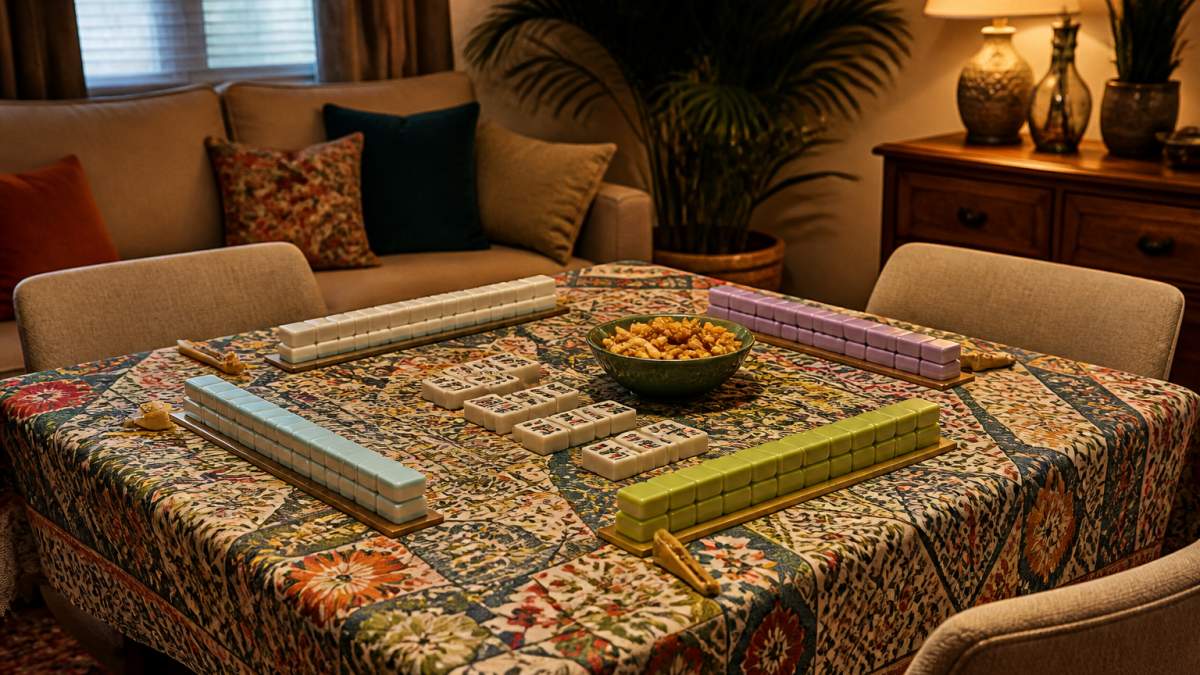
Pick a simple theme so shopping stays easy. "Boho game night" or "bright and bold" both work. Choose one color story and repeat it in the tablecloth, cups, and coasters.
Your table setup should serve the game first. A mahjong mat or fitted tablecloth keeps tiles from sliding and muffles the clatter. We recommend a square table around 34 to 36 inches wide, which fits four racks with room to spare.
Layer in decor that also works: a low centerpiece, small bowls, and paper coasters. Skip tall candles. They block sightlines across the table.
A mahjong game night schedule keeps the evening moving without rushing anyone. Send invites two weeks out, then plan on three hours of play for a first gathering. Most groups settle into a rhythm after two or three hands.

Use this hosting checklist as your working plan:
| Time Before Guests | Task |
|---|---|
| 2 weeks | Send invites, confirm player count |
| 1 week | Check tile set, racks, and mat |
| 2 days | Plan snacks and drinks, shop |
| Day before | Set the table, chill drinks |
| 2 hours before | Prep food, tidy the room |
| 30 minutes before | Light the room, set out snacks |
| On arrival | Welcome guests, assign seats |
| First 15 minutes | Teach rules, run a practice hand |
Build in a 15-minute buffer at the start. Guests always arrive in waves, and a buffer keeps early arrivals from waiting awkwardly.
Comfortable seating and good lighting decide whether players last one hour or four.
Choose chairs with backs and set them at a consistent height. Dining chairs beat bar stools.
For lighting, aim for bright, even light over the table.
Keep the room slightly cool. A crowded table warms up fast, and stuffy rooms make guests restless.
Mahjong night for beginners works best when you teach one hand at a time. Skip the full rulebook. Explain the goal, the deal, and the turn order, then play. The unique angle here is the mixed table: most hosts invite a blend of experienced players and first-timers, and the teaching plan has to keep both groups engaged without turning the evening into a lecture.
Before anyone draws a tile, cover only these five points. Everything else can wait until it comes up in play.
The Charleston is the step new players forget, and one demo prevents a dozen questions later. Walk through the first Charleston pass slowly: each player selects three tiles to pass to the right, then three to the left, then three across, then three to the right again. Do one full pass with tiles face up so everyone sees what moves where.
Run one practice hand with all tiles face up on the racks. Narrate your own turn out loud: "I'm drawing, I'm looking for a pair of eights, I'm discarding this nine of bams." Beginners learn faster by doing than by listening, and experienced players hear the vocabulary they already use.
Pair each new player with a veteran on their left, so the beginner can ask a quiet question without stopping the whole table. Rotate the pairs after the practice hand so no one feels singled out. Experienced players should be told in advance that the first two hands are teaching hands, that expectation prevents sighs and eye-rolls when play slows down.
Print a one-page reference for each player: the Charleston order, the turn direction, the minimum hand, and the joker rules. A printed card beats a phone screen because it doesn't pull eyes away from the game. Keep the current year's card visible at the table, and mark the hands your group is most likely to attempt with a sticky note.
A few house variations keep a mixed table moving:
Don't teach scoring, don't teach every hand on the card, and don't teach the optional Charleston. Those topics can wait for the second gathering. The goal of the first night is a completed hand and a group that wants to come back.
Mahjong party food ideas should be fork-free and easy to eat with one hand.
Mahjong Rack and Pusher Set of 4 - Solid Colors →
Build a snack station with:
Set drinks on a side table, not the game table. Our Bam Let's Mahj snack cups hold an 8 oz portion and make cleanup simple.

Ask about dietary needs when guests RSVP. Offer one nut-free and one gluten-free option so everyone has something to eat.
Four players fill one mahjong table. That's the number the game is built for, and it's the number to plan around. The unique angle here is the math of the guest list: most hosts over-invite, then improvise a rotation that leaves someone sitting idle for an hour. Plan the count and the rotation before the invites go out.
A standard mahjong table seats exactly four. Each player needs a rack, a pusher, and enough elbow room to stand 13 tiles without knocking a neighbor's wall. Plan on one tile set, four racks, four pushers, and one mat per table. If you own one set, your maximum comfortable player count is four.
| Guests | Tables Needed | What to Plan |
|---|---|---|
| 4 | 1 | One full table, no rotation needed |
| 5-6 | 1 | Rotation with one or two waiting players |
| 7-8 | 2 | Two tables of four, or one table plus a teaching table |
| 9-12 | 2-3 | Two full tables plus a rotation queue |
A five- or six-person guest list keeps the table full without anyone sitting idle too long. For larger groups, add a second table. You'll need a second tile set, four more racks, and another mat. Two tables of four is the sweet spot for a party.
Pick one rotation format before guests arrive and write it on a card at the table.
Keep score on one sheet per table so you can compare results at the end of the night. Note who has sat out and for how long, so the rotation stays fair.
Not every guest has to play. Set up a side area with snacks, drinks, and a chair with a view of the table, and let waiting players watch and chat. Watching a hand is how most beginners learn the rhythm. If you have a second set, run a teaching table for the extras rather than making them wait.
Leave at least 30 inches between seats so players can move tiles without bumping elbows, and leave a walkway behind each chair so waiting players can move around the table without squeezing past. Two tables need roughly 8 feet between them if both have players seated on the facing sides.
If you own one tile set and one mat, cap the guest list at six. Beyond six, the waiting time per player grows faster than the fun, and the host spends the evening managing seats instead of playing. A second set is the better investment once your group regularly tops six.
Most hosting problems have simple fixes. A tile goes missing, a player gets confused, or the night runs long. Plan for all three.
Common fixes:
Cleanup goes faster with a system. Have each player return their own rack and pusher to the box.
Store the set together so next month's setup takes minutes, not an hour.
Hosting a mahjong game night takes a little planning and the right gear. Home 2 Court carries the pieces that make setup easy: our mahjong rack and pusher set in solid colors, a boho Charleston rules tablecloth, and mahjong tile drink coasters that protect your table.

American Mahjong is built for four players, so a full table needs four people. If you have more guests, set up a second table or rotate players in and out between rounds. With three players you can play a modified version, but the game works best with four. For a mahjong game night with beginners, plan for one experienced player per table to keep the game moving and answer rules questions.
At minimum you need a mahjong tile set, four racks and pushers, a mat or tablecloth, and scorecards or a scoring app. Add comfortable seating, good lighting, snacks, and drinks to round out the evening. A dedicated mahjong tablecloth keeps tiles from sliding and protects your table. Snack cups and coasters also help keep food and drinks away from the tiles, which matters when guests are leaning over the table.
Most casual mahjong game nights run two to three hours, including setup, teaching, and a snack break. A single hand takes about 10 to 15 minutes once players know the rules. Beginners should plan for a longer first hour while everyone learns. Build your mahjong game night schedule around three or four rounds with breaks in between, and let guests know the expected end time so they can plan their evening.
Choose foods that are easy to eat with one hand and won't leave grease or crumbs on the tiles. Popcorn, nuts, candy, and small appetizers in paper cups work well. Set drinks on coasters at a side table rather than on the playing surface. For mahjong party food ideas, keep portions small so guests can snack between rounds without interrupting play, and offer sparkling water alongside other drinks.
