No Products in the Cart


Last Updated: September 16, 2026
A personalized wedding gift works because it refuses to be generic. When you are figuring out how to choose personalized wedding gifts, the goal is simple: give the couple something that could only belong to them. A monogrammed keepsake outlasts a dozen forgettable boxed sets.
Here is the tension most gift guides ignore. A mass-produced gift says "I needed something." A customized gift says "I know you." That difference is why couples keep engraved items on a shelf for decades and quietly re-gift the rest.
Below, we break down how to pick personalization that fits, what it costs, and when to order so nothing arrives late.
Choosing personalization comes down to three decisions: what to mark, how to mark it, and when the couple will actually use it. Get those right and almost any gift lands.
Start with the item's role in their life. A monogrammed tote gets used weekly; an engraved frame gets looked at daily. Both work, but they serve different moments.
Traditional monogramming etiquette uses the bride's first initial, the shared last initial in the center and larger, then the groom's first initial. For a couple named Anna and Mark Rivera, that reads ARM. Many modern couples prefer a simple shared last initial, and either is acceptable.
Two rules still hold. Never monogram a gift the couple might exchange or return, and never put a wedding date on an item until the date is locked. A common mistake is ordering monogrammed goods before the venue and date are confirmed.
Unique personalized wedding gift ideas share one trait: they are useful and specific at the same time. The best ones get used, not stored. What separates a genuinely thoughtful custom gift from a generic one is rarely the product category, it is whether the personalization matches how the couple will actually live with the object.
A useful filter is to sort every idea by how often the couple will encounter it. Daily-use items (glassware, linens, a serving board) earn their place on a counter or in a cabinet. Weekly-use items (a tote, a travel case) get pulled out for errands and trips. Occasional items (a framed print, an engraved box) are looked at, not handled. None of these is wrong, but the frequency tells you how much the personalization will actually register.
Engraved keepsakes are the closest thing to an heirloom you can buy new. A handcrafted box, a framed print, or a piece of custom glassware with the wedding date engraved becomes something the couple hands down rather than replaces.
What most guides miss is that engraving rewards simplicity. A clean date and two initials age better than a long inscription that dates the piece to one trend. A short line, a date, a place, two initials, reads as timeless in ten years; a paragraph of sentiment reads as a scrapbook page.
Material matters as much as the mark. If the goal is an heirloom, ask what the base material is before you ask what the font is.
Personalized photo gifts turn a shared memory into a daily object, and custom glassware does the same for entertaining. A set of monogrammed glasses gets pulled out at every dinner party the couple hosts, which is exactly the point.
Two practical rules keep photo gifts from looking cheap. First, match the image to the surface: a high-contrast, tightly cropped photo reproduces well on glass and metal, while a wide, busy shot muddies on anything but a flat print. Second, choose a process that will not fade.
If you are unsure which to pick, choose the item they will use in front of guests.
Custom stationery is the most overlooked category in most gift guides, and it is one of the most useful. A set of monogrammed note cards or a personalized address stamp gives the couple a reason to use their new shared name, which is exactly what newlyweds want in the first year.
How much to spend on a wedding gift depends on your relationship, not a fixed rule. A common approach is to spend more for close friends and family and less for casual acquaintances, and to treat the registry as a guide rather than a mandate.
A practical way to set a number:
Personalized home decor for newlyweds should match the home they are actually building, not the one in a catalog. Ask where they live, how they host, and what they already own before you buy a single piece. A monogrammed item that clashes with the couple's existing style gets tucked in a closet; the same item in the right palette becomes part of the room.
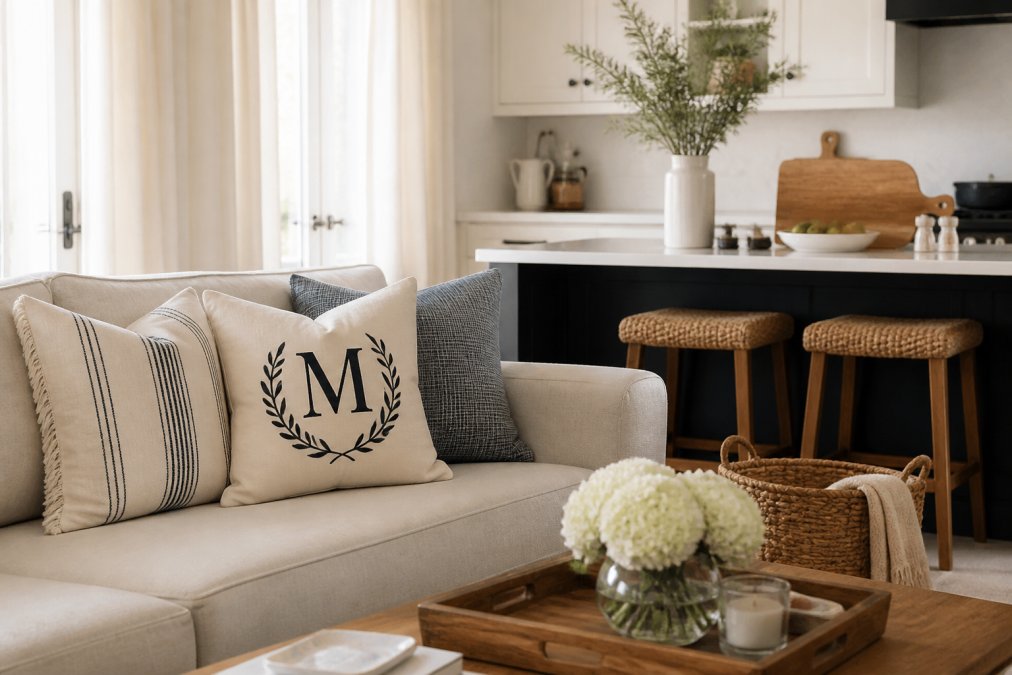
Three questions do most of the work:
The single biggest mistake in personalized home decor is choosing the object before choosing the room. A monogrammed throw pillow is a great gift for a couple with a neutral sofa and a clear color palette; it is a poor gift for a couple whose living room is already busy with pattern. The personalization should be the accent, not the conflict.
A growing share of couples care about where their home goods come from, and personalized decor is no exception. The good news is that the materials that take personalization best are also the ones that last.
Personalization lead times are the single biggest reason wedding gifts arrive late. Customization adds processing time on top of standard shipping, and most vendors will not rush it.
Plan backward from the wedding date:
| Timeline | Action |
|---|---|
| 8-10 weeks out | Choose the item and confirm spelling |
| 6-8 weeks out | Place the personalization order |
| 3-4 weeks out | Confirm shipping and tracking |
| 1 week out | Ship to the couple or bring it in person |
Personalized gifts for second marriages and older couples need a different approach, because these couples usually already own a full home. Adding a fifteenth serving dish is not a gift; it is a chore.
A good personalized wedding gift combines everyday usefulness with a detail tied to the couple, such as their initials, wedding date, or shared surname. Engraved keepsakes, monogrammed accessories, and customized kitchenware all work well because they get used rather than stored away. A monogramable tote bag at $157 or a satin-lined jewelry box at $72 shows the same thought as a larger piece. Match the item to how the couple actually lives, not to what looks impressive in a photo.
For many weddings, $300 from a couple is generous and lands above the typical $100 to $200 range per guest. The number should track your relationship to the couple, your travel costs, and your budget rather than a fixed rule. If you are close family or the couple is covering a destination stay, $300 is reasonable. If you are a coworker or plus-one, a smaller personalized gift with real thought behind it works just as well.
Keep the personalization to one element: initials, a wedding date, or a short phrase. A monogrammed patch on a terry tote bag or a single embroidered detail on a jewelry box reads as thoughtful, while engraved poems and multiple monograms cross into excessive. Use the couple's shared last name only when you know they are both taking it, and use first initials when you are unsure. Restraint is what makes personalization feel elegant rather than forced.
Order at least four to six weeks before the wedding date. Monogramming and engraving add production time on top of standard shipping, and peak wedding season from May through October stretches those timelines further. If you are ordering within two weeks of the wedding, choose an in-stock personalized accessory you can hand over at the reception, or send a card with a note that the customized piece is on its way. Confirm the personalization details in writing before you pay.
Choosing a personalized wedding gift is a test of attention more than budget. The couples you love are not counting what you spent; they are noticing whether you understood them. At Home 2 Court, our curated home decor, gifts, and bridal registry services are built for exactly this, from monogrammable accessories to keepsake boxes that hold what matters. Get started with Home 2 Court and give a gift the couple keeps for decades.
