No Products in the Cart


Last Updated: September 16, 2026
Customized home decor is the practice of adding names, monograms, dates, or personal designs to functional home pieces so they carry meaning beyond their utility. According to The Knot's wedding registry research, couples increasingly prioritize pieces that reflect their shared identity rather than generic housewares. This guide from Home 2 Court explains how to build a registry around personalized wedding gifts for couples that you will actually keep for decades.
Learning how to choose wedding registry items starts with your actual floor plan, not a generic checklist. Walk through each room and note what you reach for daily. That list, not a retailer's suggestion, should drive your registry.
Register for the spaces where you spend real time. A couple who cooks nightly needs different basics than one who hosts twice a year. Count your typical week: kitchen, living room, bathroom, bedroom. Prioritize those four.
A cohesive registry mixes workhorses with statement pieces. A personalized tea towel earns its place because it gets used and seen. A decorative tray earns its place because it anchors a surface. Aim for roughly two functional items for every decorative one.
| Registry Category | Example Piece | Why It Works |
|---|---|---|
| Everyday function | Cotton tea towel | Used daily, easy to personalize |
| Entertaining | Lacquered book topper tray | Anchors a coffee table or bedside |
| Small accents | Porcelain trinket tray | Catches keys, rings, small keepsakes |
| Kitchen utility | Kitchen towel | Practical, expressive, long-lasting |
Personalized wedding gifts for couples work best when the customization stays subtle. A monogrammed piece should look intentional in five years, not dated. Choose a single initial, a wedding date, or a short phrase over busy designs that clash with future decor changes.

Tabletop and entertaining essentials are the pieces guests notice first, and they are also the pieces most likely to sit unused if you register by category instead of by scenario. A registry that covers serving, styling, and storage handles nearly every gathering, from a casual brunch to a holiday dinner, but only if each piece has a job you can name before you add it.
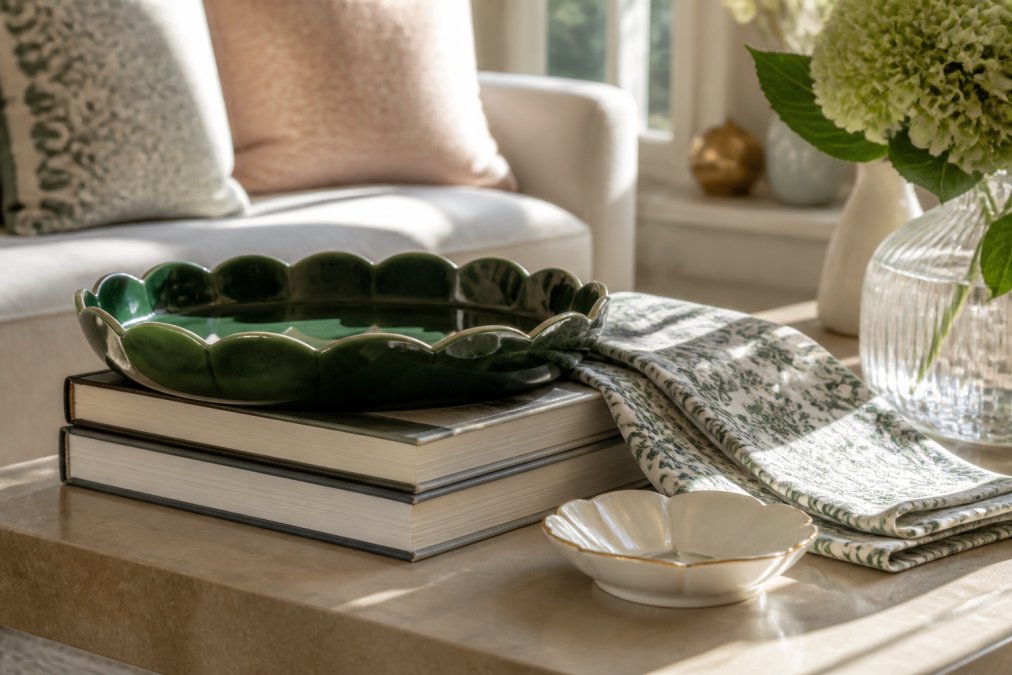
Most couples over-register on flatware and under-register on surfaces. A practical rule is to cover three sizes: a small catchall (under 8 inches), a medium tray (roughly 8 by 12 inches), and one large platter or board for a main dish. Anything beyond that duplicates a job you already filled.
Material choice determines whether a piece survives its first year of hosting. Lacquered finishes resist water rings and wipe clean. Porcelain handles heat and resists staining, so it works for trinket dishes and small serving pieces. Cotton absorbs and dries quickly, which is why it outperforms polyester for towels that touch glassware.
Run your list against four real situations before you finalize it:
Entertaining sets matter because they get used in front of guests. Register for pieces that look good empty, not just full, and that you can store without rearranging an entire cabinet.
Small-space living demands pieces that do more than one job, and most registry checklists ignore that entirely. A registry built for a 600-square-foot apartment looks different from one built for a house, not because the couple wants less, but because every item has to justify the cubic feet it occupies.
Before you register, count your actual storage: cabinet depth, drawer count, and shelf height. A common pattern is that couples in apartments have roughly half the cabinet depth of a suburban kitchen and no dedicated pantry. That single constraint rules out most large platters, full sets of specialty bakeware, and oversized serving bowls.
Measure three things before you add any decor item:
Choose items that nest, stack, or serve double duty. A tray that works as a bedside catchall and a serving surface saves a purchase. A tea towel that doubles as a decorative wall hanging frees cabinet space. The Kitchen Towel at $26.00 comes in cotton twill or polyester, so couples can match the material to how they actually cook and clean, cotton twill for absorbency, polyester for quick drying in a bathroom with no window.

Apply the rule by room:
When floor and counter space run out, go up. Wall-mounted hooks, over-door racks, and stackable trays convert unused vertical inches into storage. Nesting bowls and collapsible colanders are the two categories where small-space couples get the most return per dollar, because they shrink to a fraction of their in-use size.
Some registry staples simply do not earn their footprint in a small home. Large serving platters, full china sets for twelve, specialty bakeware like bundt pans and tart tins, and oversized decorative vases are the most common regrets. Register for one of each only after you host your first few gatherings and confirm you reach for it.
Personalized pieces do more work per square foot than generic ones, because they carry emotional weight that justifies keeping them out rather than stored away. A monogrammed tea towel on a hook, a printed trinket tray by the door, and a lacquered tray on the coffee table replace three decorative objects with three functional ones.
Eco-friendly decor and budget-friendly customization are not opposites. Couples can build a sustainable registry without abandoning personal touches, and they can personalize pieces without overspending.
Material choice determines how long a piece survives. Organic cotton, porcelain, and lacquered finishes resist daily wear better than thin synthetics. Home 2 Court's Cotton Tea Towel is vegan and made from controlled, organically cultivated cotton, which means it holds softness through repeated washing. The Trinket Tray at $30.00 is porcelain, a material that resists staining and chips far less than plastic alternatives.

Custom does not require a custom price. Focus personalization on one or two high-visibility pieces rather than the entire registry. A monogrammed tea towel costs less than a custom piece of furniture and delivers a similar emotional payoff.
Caring for your customized home decor comes down to three habits: wash gently, store dry, and keep printed surfaces out of direct sun. These simple routines keep custom pieces looking new through years of daily use.
Look beyond the standard pots and pans. Customized home decor gives guests something memorable to gift, like a monogrammed porcelain trinket tray or a personalized tea towel printed with your wedding date. Pair those with a lacquered book topper tray that doubles as a bedside catchall. The goal is a registry that reflects how you actually live, not a generic checklist. Mix one or two statement pieces with everyday items you will use weekly, and your registry stays both practical and personal.
No. Registries exist to tell guests what you genuinely want, and customized home decor is no different from asking for dishes or linens. The etiquette rule is about clarity, not restraint: list specific items with prices so guests can choose comfortably. Personalized pieces often become the gifts guests most enjoy giving because they feel considered rather than generic. Just avoid listing only high-ticket custom items. Include a range of price points so every guest can participate at a level that works for them.
Group items by room or moment so guests can shop with intention. A kitchen section might feature a personalized tea towel and a printed kitchen towel, while a bedroom section highlights a porcelain trinket tray for rings and jewelry. Add short notes explaining why each piece matters to you, such as "for our first dinner parties." This helps guests understand the vision and pick something meaningful. Many couples also keep a small number of group-gift options for larger custom pieces.
Start with what you touch daily: kitchen towels, a tray for corralling keys and mail, and small dishes for jewelry or bathroom odds and ends. Customized home decor covers several of these at once because a personalized tea towel works as hard as a plain one, and a lacquered tray keeps surfaces tidy while looking intentional. From there, add entertaining pieces if you host, and storage-friendly decor if space is tight. Build the list around your routines first, then layer in the decorative extras.
Building a registry that feels personal, functional, and built to last takes more thought than checking boxes on a generic list. Home 2 Court offers a curated selection of porcelain trinket trays, organic cotton tea towels, and lacquered book topper trays, plus bridal gift and registry services that help couples choose pieces matching their actual home and style. Get started with Home 2 Court and create a registry your future self will thank you for.
