No Products in the Cart


Last Updated: September 10, 2026
The best pickleball court accessories solve three problems: protecting your playing surface, keeping your gear organized, and reducing small frustrations. This Home 2 Court guide breaks down the equipment worth owning in 2026. Pickleball court accessories range from $14 grip pouches to $184 tournament totes, and knowing which ones earn their place in your bag saves money and court time.
| Accessory Category | Price Range | Best For | Priority |
|---|---|---|---|
| Water bottle pouch | $14 | Hands-free hydration | High |
| Portable net system | Varies by brand | Driveway and park play | High |
| Court markers and boundary kits | Varies by brand | Temporary courts | Medium |
| Tote or backpack | $36-$184 | Gear organization | High |
| Paddle care kit | Varies by brand | Equipment longevity | Medium |
The categories below start with the equipment that protects your investment.

Court maintenance equipment is any tool used to clean, repair, or protect a playing surface between sessions. A clean, well-tensioned court plays faster and reduces ball bounce inconsistency.
Debris is the enemy of consistent play. A soft-bristle push broom or dedicated court sweeper removes leaves, pebbles, and dust before they work into the surface; a leaf blower handles larger outdoor debris. Indoor facilities typically use microfiber mops that won't scratch acrylic or painted lines. The common mistake is a stiff-bristle broom on painted surfaces, which scuffs boundary lines over time.
Net tensioning tools keep the net at regulation height and tightness, which directly affects ball trajectory. Edge guard tape protects the exposed edges of your net and the court perimeter from wear; weather-resistant tape lasts longer outdoors, while indoor courts can use lighter adhesive options.
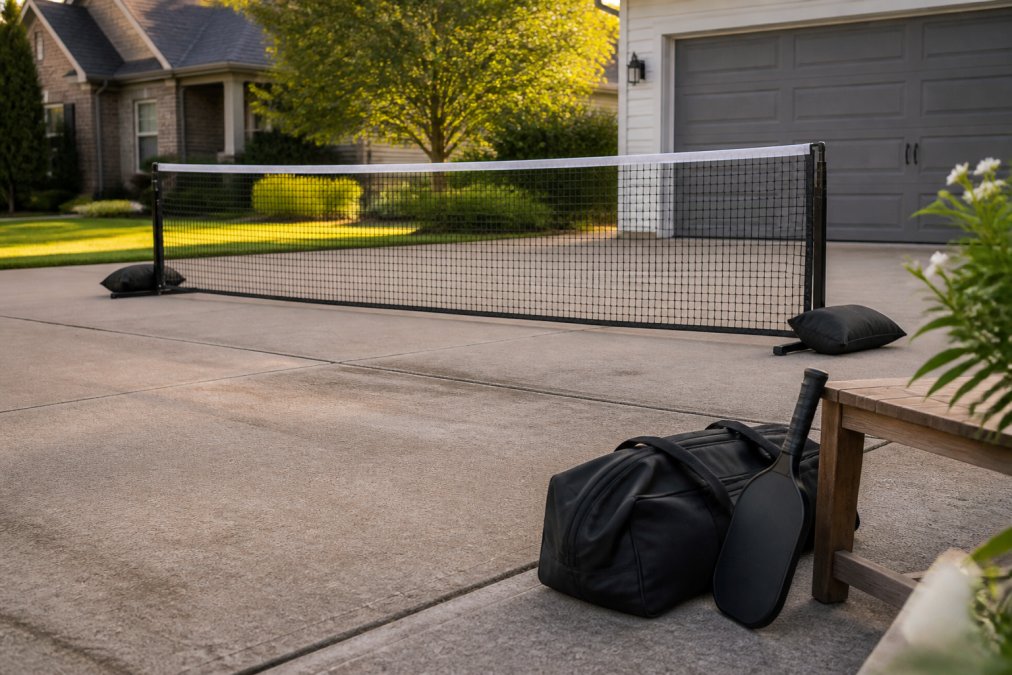
A portable net system is a freestanding net assembly that sets up and comes down without permanent installation, making driveway, park, and gym play possible anywhere there's flat ground. The trade-off versus a permanent net is stability and setup time, and that's where most buying decisions get made.
A regulation pickleball net is 36 inches high at the sidelines and 34 inches at the center, spanning 22 feet (usapickleball.org). Cheaper portable systems often ship with a flat 34- or 36-inch net that ignores the center sag, changing ball trajectory on dinks and third-shot drops. If you plan to practice seriously or host games, look for a system that specifies the 36/34 taper; systems that don't list dimensions are usually flat-net kits for casual driveway play.
Two frame designs dominate the portable category:
Many players buy a pop-up for convenience, then upgrade to pole-and-base within a season of hosting regular games.
The biggest complaint about portable nets is wobble. Net weights, sandbags, or weighted base plates anchor the frame and stop it shifting during play, wind is the main culprit, and a net that moves mid-rally ruins the experience. Look for weights that attach to the base rather than the net, since top-mounted weights can distort tension.
Concrete specifics worth knowing:
Portable net bases sit directly on the playing surface, and that contact point matters. Rubber-footed bases protect acrylic and painted surfaces from scuffs, while unpadded metal bases will mar a driveway or gym floor over time. On sport-court tiles or modular surfaces, check that the base footprint doesn't overlap the non-volley zone line, or you'll create a tripping hazard at the kitchen edge.
A portable net is only as portable as its bag. Look for a shoulder strap, a separate compartment for the net (so wet netting doesn't soak the frame), and room for the weights. Systems shipping with a thin drawstring bag usually get replaced within months; a wheeled bag is worth the upgrade if you haul the system more than a short walk from the car.
Ball retrievers are long-handled tools that pick up balls without bending, and they matter more as you age or play longer sessions. A rolling cage design collects multiple balls in one pass, speeding up drills considerably.
Court coverage tools go beyond retrieval. A ball hopper holds dozens of balls at waist height for serving practice, while a teaching cart organizes balls, paddles, and water for coaches. For solo practice, a hopper paired with a retriever turns a bucket of balls into an efficient drill setup.
Paddle care accessories extend the life of your most expensive piece of equipment. A quality paddle can cost more than every other accessory combined, so protecting it pays off.
Overgrips wrap over your existing handle to improve tackiness and absorb sweat, cheap, replaceable, and the fastest fix for a slick grip. Replacement grips go underneath and restore the handle's original cushioning when it wears flat. Grip enhancers like powders and tacky sprays help sweaty hands in humid conditions, but moisture-wicking overgrips are the better long-term choice.
Edge guard tape protects the paddle's perimeter from chips and cracks, where most damage happens when a paddle hits the ground. Paddle erasers remove ball residue and dirt from the face, restoring spin consistency. A common mistake is using household cleaners on a paddle face; they break down the surface texture that generates spin.
Comfort and safety gear reduces injury risk and keeps you playing longer. Most guides stop at "wear sunscreen and bring water," but the gear that matters depends on your conditions, outdoor players in extreme heat, high humidity, or wind face problems indoor players never think about. This section covers core safety items first, then climate-specific accessories.
Protective eyewear guards against errant balls and paddle contact, a real concern in fast net exchanges, a deflected ball can reach the face faster than a blink. Look for polycarbonate lenses rated for impact (ANSI Z87.1 is the standard) (osha.gov). Wraparound styles stay put during quick head movement better than flat-lens sunglasses, and sport-specific prescription inserts are available from most eyewear brands.
Performance footwear with court-specific grip prevents slips on acrylic and concrete. Running shoes are the wrong choice, their tread is built for forward motion, not pickleball's lateral cuts, and the cushioning is too soft for hard courts. Look for a herringbone or modified herringbone outsole, a reinforced toe for drag, and a low-to-mid profile for lateral stability.
Ergonomic accessories like padded grips and supportive insoles address joint stress that builds over repeated sessions. Insoles with arch support help players logging multiple sessions a week, especially on concrete, which transmits more shock than acrylic.
High heat and humidity change what you need on court:
Wind is the most underrated condition in outdoor pickleball. It affects ball flight more than most players account for, and it makes portable nets unstable. Gear that helps:
For outdoor play, sun protection is a safety item, not a comfort item. A wide-brim hat or visor, UV-rated sunglasses, and SPF 30+ sunscreen cover the basics. Reapply every two hours, and don't forget the back of the neck and the tops of the ears, the two most commonly missed spots (the American Academy of Dermatology).
Court marking kits create temporary or permanent boundary lines on any flat surface. Temporary kits use tape or chalk for driveway courts you set up and remove; permanent kits use paint or adhesive lines for dedicated spaces. Boundary lines matter because pickleball's kitchen and service areas have specific dimensions, and eyeballing them leads to disputes. Weather-resistant markers hold up through rain and foot traffic, while indoor markers prioritize clean removal.
The right storage solution keeps everything in one place and protects your equipment between sessions. A dedicated pickleball bag prevents paddles from getting crushed and keeps small accessories from scattering.
Home 2 Court's Melbourne Pickleball Backpack/Tote ($184) solves the tipping problem that plagues most bags with a tip-free design that stays upright on the court. It holds a change of clothes and extra shoes, with pockets sized for sunglasses, phones, and balls. For players who want a lighter option, The Lola Pickleball Tote ($100) fits up to three paddles in a zippered compartment and includes carabiner hooks for court fencing. Players who carry the essentials and nothing more can add the Pickleball Paddle Water Bottle Pouch ($13.99), a neoprene sleeve with an adjustable strap that keeps keys, cards, and a water bottle off the ground.

Start with a quality paddle, then add overgrip and edge guard tape to protect it. For the court itself, you need portable net systems with proper net weights, court markers for boundary lines, and a ball hopper or retriever to cut down on bending. A water bottle pouch and a gear bag with dedicated paddle compartments keep everything organized. Safety gear like protective eyewear and moisture-wicking apparel round out the essentials for regular play.
Sweep the surface regularly to remove debris that can affect ball bounce. Use a soft-bristle broom or court sweeper for routine cleaning. Check net tensioning every few sessions and adjust as needed. Apply edge guard tape to high-wear areas and inspect for cracks or lifting. For outdoor courts, clear standing water promptly and avoid harsh chemicals that degrade the surface coating. A small investment in pickleball court maintenance equipment extends your court's lifespan significantly.
Yes, if you want flexibility. Portable pickleball net systems let you set up on a driveway, gym floor, or any flat surface without permanent installation. Look for models with adjustable net tensioning and weighted bases for stability. Net weights or sandbags prevent tipping during play. They cost less than permanent nets and store easily when not in use, making them ideal for homeowners who play casually or want to introduce friends to the game.
Pick a retriever that matches your volume of play. Simple tube retrievers work for casual players who pick up a few balls at a time. Ball hoppers and teaching carts hold 30 to 80 balls and eliminate constant bending during practice sessions. Look for lightweight aluminum frames, durable mesh baskets, and wheels if you plan to move it around the court. A retriever with an ergonomic handle reduces strain and keeps your focus on drilling.
Use a dedicated pickleball bag with separate compartments for paddles, balls, water bottles, and personal items. Tote bags with zippered paddle sections protect your equipment from scratches. Add a water bottle pouch to free your hands and keep essentials off the ground. For home storage, wall hooks or a gear rack keep paddles and bags accessible. A small organizer for grip tape, lead tape, and replacement grips ensures you never scramble before a match.
Pickleball gear only works as well as the system holding it together. Home 2 Court curates equipment for players who want their gear organized, protected, and ready to play, from tip-free totes to paddle pouches designed for the court. Browse the collection and build a setup that keeps you playing longer with less hassle.
