No Products in the Cart


Last Updated: September 9, 2026
Most new players assume that buying professional-level pickleball gear will fast-track their improvement. In practice, that premium equipment often masks poor fundamentals and slows down skill development. The truth is that beginner pickleball gear vs professional equipment comes down to matching the tool to your current skill level, not just your budget. The most common mistake players make is overspending on gear that works against a developing game.
The core tension is simple: professional paddles are engineered for players with consistent mechanics who generate their own power. A beginner who buys a power-focused pro paddle often loses control and develops bad habits compensating for the extra pop. What you need at each stage depends on your swing speed, your playing style, and how often you're on the court.
Beginner pickleball gear is equipment designed to prioritize forgiveness, control, and durability over raw performance. Professional pickleball gear, by contrast, maximizes spin, power, and precision for players with refined technique.
The fastest way to understand the market is to see the categories side by side. Everything in your bag, from the paddle to the shoes, serves a different purpose depending on whether you're learning the game or competing at a high level.
| Gear Category | Beginner Focus | Professional Focus | Best Strategy |
|---|---|---|---|
| Paddle Weight | 7.5-8.0 oz for control | 7.8-8.4 oz for power | Start lighter, add weight |
| Paddle Core | Polymer honeycomb, softer feel | Polypropylene honeycomb, responsive | Prioritize feel first |
| Paddle Face | Fiberglass for forgiveness | Raw carbon fiber for spin | Upgrade when consistent |
| Shoes | Court shoes, lateral support | Lightweight, high-cushion court shoes | Never use running shoes |
| Balls | Outdoor 40-hole for durability | Same spec, premium brand feel | Buy mid-range, replace often |
This table distills the key differences, but the real insight is in the paddle technology. That's where most of your budget should go, and where most players make their biggest mistakes.

Most guides stop at 'carbon fiber is better than fiberglass.' That misses the mechanical reality of how a paddle's construction interacts with your body, and why that matters for injury prevention, not just performance. The three components that decide performance are the face, the core, and the edge guard, but the way they transmit force to your wrist, elbow, and shoulder is the overlooked variable.
The paddle face determines spin and surface texture. Entry-level paddles typically use fiberglass, which offers a decent balance of power and control at a lower cost. Professional paddles use raw carbon fiber, often in multiple layers, to generate superior spin and a crisper response. The Selkirk VANGUARD Pro Invikta Raw Carbon uses four layers of 12K raw carbon fiber, double the standard found in many paddles. That construction enhances feel, spin, and power, but it demands consistent mechanics to use well.
The core absorbs vibration and defines your sweet spot. Most modern paddles use a polypropylene honeycomb core, with thickness dictating feel. A 16mm core, like the X5+ found in the VANGUARD Control series, provides a softer feel and larger sweet spot, ideal for learning third shot drops and resets. Thinner cores generate more power but punish off-center hits.

Here is where the injury angle comes in. A stiffer, thinner core (often found in pro power paddles) transmits more shock to your elbow on every off-center hit. For a beginner with inconsistent contact, that repeated micro-trauma can contribute to lateral epicondylitis, commonly known as pickleball elbow. A 16mm polymer core can act as a vibration dampener, absorbing a significant portion of that shock before it reaches your forearm (PubMed). The paddle can be a line of defense against overuse injuries, not just a tool for shot-making.
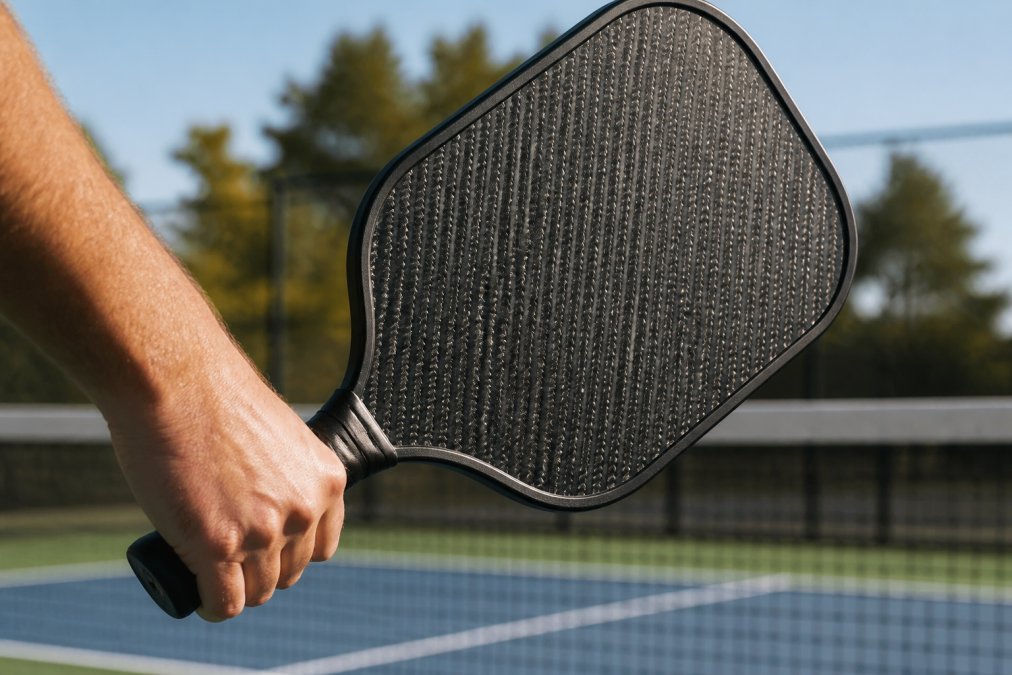
Beyond the core, consider the edge guard. A thicker, more durable edge guard protects the paddle from scrapes, but it also adds weight to the perimeter, shifting the balance point toward the head and potentially straining your wrist on repeated volleys. Professional paddles often use a slim, low-profile edge guard to keep the balance point closer to the handle. For a beginner, a slightly thicker guard is a trade-off worth making for durability, but be aware it changes how the paddle feels.
Finally, consider the grip. A worn or slick grip forces you to squeeze harder, tensing your forearm muscles and reducing blood flow, which contributes to fatigue and injury. Replacing your grip tape every few months is the cheapest injury-prevention upgrade you can make, allowing a relaxed, injury-free swing.
When you're searching for the best pickleball paddles for beginners, ignore the marketing and focus on three specs: weight, grip size, and core thickness. These features determine whether the paddle feels like an extension of your arm or a liability on every shot.
For most beginners, a control-oriented paddle is the right call. The VANGUARD Control series, with its T700 Raw QuadCarbon Fiber face and traditional build, offers supreme spin while maintaining control that builds confidence. The lightweight version at $199.99 suits players who prioritize quick hands at the net, while the midweight version provides a bit more stability on drives.

How to choose pickleball shoes starts with understanding that running shoes are designed for forward motion, while pickleball demands lateral movement. Running shoes lack the support structure needed for side-to-side shuffles and quick direction changes, which puts your ankles at risk.
Court shoes are the only sensible choice for pickleball. They feature non-marking soles designed for the surface, reinforced lateral support, and cushioning tuned for multidirectional stress. When you're comparing beginner pickleball gear vs professional equipment, shoes are one area where you should not skimp at any level, because injury prevention matters more than paddle performance.
Look for these features in a court shoe:
A common mistake is wearing worn-down court shoes. The grip that protects your joints degrades faster than the visible tread suggests. If you play multiple times per week, replace your shoes every six to nine months.
The differences between beginner and professional gear extend beyond the paddle. Balls, bags, and accessories carry their own trade-offs, and here you can save money without sacrificing your development.
Balls are the most straightforward. Indoor balls have larger holes and play softer, while outdoor balls use 40 smaller holes for wind resistance and durability. Beginners should buy mid-range outdoor balls that hold their shape, since cracked balls create unpredictable bounces that teach you nothing about your actual shots. The USA Pickleball standard for outdoor balls is a 40-hole design, and most reputable brands meet this spec.
Bags are where budget players can save significantly. A basic backpack-style pickleball bag holds two paddles and a few balls, which is all you need for your first year. Professional players often invest in larger tournament bags with dedicated compartments for shoes, apparel, and multiple paddles, but that's a convenience purchase, not a performance one.
A pickleball gear upgrade timeline prevents you from either stagnating with beginner equipment or jumping to pro gear too soon. The calendar is a poor proxy for readiness. Instead of counting months, measure your skill against specific, observable benchmarks. When you hit those, the gear upgrade is justified, not before.
Phase 1: The Control Foundation (Skill Benchmark: Consistent Contact)
You are here if you can sustain a 10-shot rally with a partner without unforced errors on 7 out of 10 attempts. Your gear: a midweight control paddle (7.5-8.0 oz) with a 16mm polymer core, such as the VANGUARD Control Epic Midweight at $199.99. Your focus is developing a reliable serve, learning third shot drops, and understanding court positioning. Do not upgrade your paddle until you can place your third shot drop within the kitchen on 5 of 10 attempts, if you cannot, the paddle is not the limiting factor.
Phase 2: The Style Assessment (Skill Benchmark: Intentional Shot Selection)
You are here when you can consistently execute a drop shot and a drive from the same position, choosing between them based on your opponent's positioning. By now, you should know whether you prefer a control game built on dinking and resets or an aggressive style with drives and put-aways. Control players stay with the VANGUARD Control line; power players should look toward the VANGUARD Power Air series. Players who skip this assessment and jump straight to a power paddle often lose control of their dinks and develop a death grip to compensate, a habit that is hard to break.
Phase 3: The Performance Upgrade (Skill Benchmark: Rally Control)
When your swing speed is consistent and your shots land where you intend them most of the time, you're ready for professional-level equipment. The VANGUARD Pro Invikta Raw Carbon at $229.99 offers all-court versatility for intermediate to advanced play. The Power Air Epic Prestige at $249.99, with its Thermoformed construction and ProSpin+ NextGen texture, suits players who want maximum spin and power. The benchmark is simple: you can control the pace of a rally. If you can slow the game down or speed it up at will, your technique is ready for a paddle that amplifies your input. If the game controls you, stick with your control paddle.
Ongoing: Maintenance as a Skill
Maintenance is a performance and safety practice. Replace your grip tape when it feels slick, typically every 4 to 6 weeks if you play multiple times per week. A slick grip forces a tighter hold, increasing injury risk. Check your edge guard for cracks after hard hits; a cracked guard can expose the core to moisture, degrading the honeycomb structure. Store paddles away from extreme heat, such as a car trunk in summer, as heat can warp the core and delaminate the face. A well-maintained paddle lasts years; a neglected one loses its performance within months.
The transition from beginner to intermediate is the moment most players overbuy. Resist the urge. As documented in USA Pickleball's equipment guidelines, the sport's governing body emphasizes that paddle specifications matter less than player readiness and technique. Similarly, the American Council on Exercise's guidance on court sport footwear underscores that proper shoes prevent the lateral ankle injuries common in racket sports. Your upgrade timeline should follow your skill, not the newest product release. When you can consistently execute resets and control the pace of a rally, your pickleball gear has done its job. That's the moment to invest in the performance-grade paddle that matches your style, whether that's the spin-heavy control of the VANGUARD series or the power-focused Air line.
The main difference is construction. Beginner paddles typically use fiberglass or composite faces with a thicker polymer core, prioritizing durability and forgiveness. Professional paddles, like the Selkirk Vanguard series, use raw carbon fiber faces, often in multiple layers, with advanced core materials. This can create more spin, a larger sweet spot, and better control for shots like third-shot drops. For a beginner, that added precision may be hard to feel and might not immediately improve learning, making a premium paddle a poor first investment.
Yes. Professional players wear court shoes designed specifically for pickleball or tennis. These shoes offer lateral support for side-to-side movement, non-marking soles, and reinforced toe areas for drags. Running shoes are built for forward motion and lack that stability, which can lead to rolled ankles. Beginners should prioritize proper court shoes from the start. It is a crucial piece of beginner gear where buying quality immediately matters.
Most players see clear benefits from upgrading when they play consistently for six months to a year. That is the point where your shots become intentional and you can feel the difference between a paddle that offers control versus raw power. If you are still learning proper form and dinking technique, a beginner paddle is fine. Once you start developing spin or finding that your current paddle limits your third-shot drop, follow a gear upgrade timeline and move to a performance-grade paddle.
Generally, no. An expensive paddle may not immediately make a beginner a better player. The advanced carbon fiber faces and thermoformed cores used in professional paddles are designed to enhance spin and control for players with consistent, developed strokes. For new players, a mid-range paddle that offers a good balance of control and power is often a smarter purchase. Focus your budget on high-quality court shoes and lessons. Upgrade to a premium paddle when your skill level demands its specific performance characteristics.
